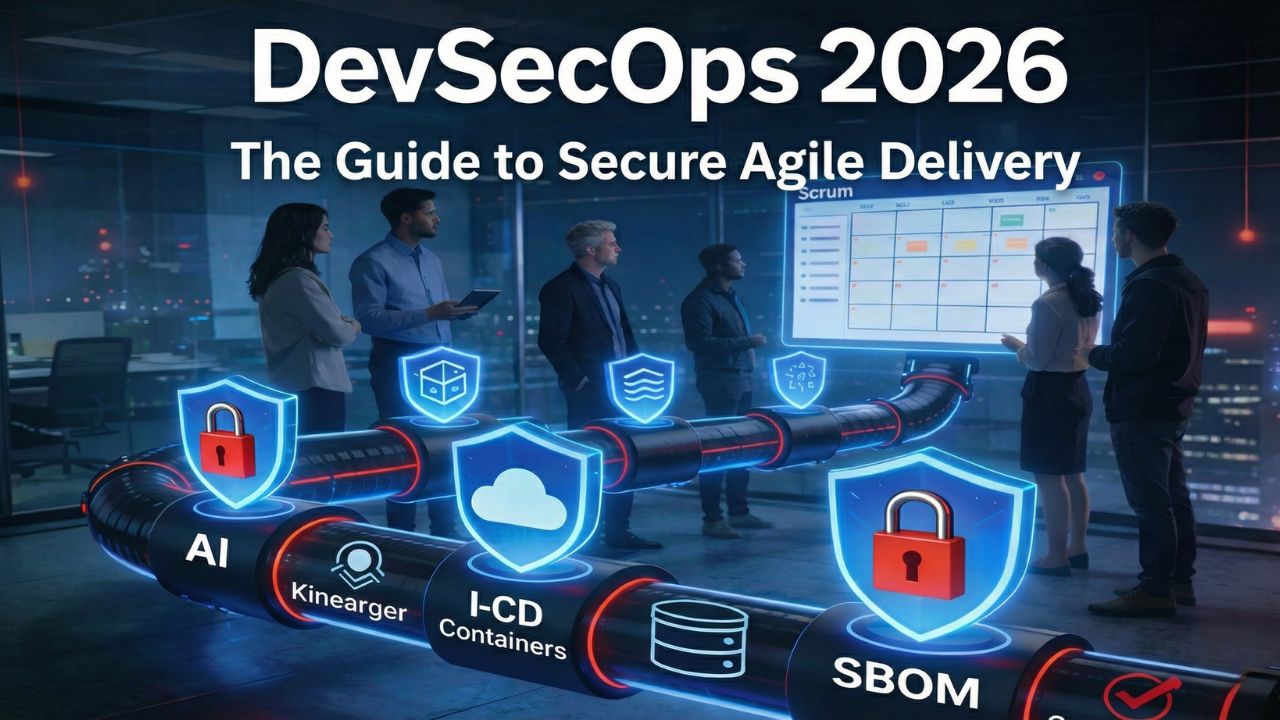
DevSecOps 2026: The Guide to Secure Agile Delivery
Traditional Scrum is too slow for modern threats. If you are shipping code every two weeks but security checks take two months, you aren’t Agile—you’re vulnerable.
In the race to maximize velocity, security is often treated as a final hurdle—a blocker that "The Department of No" throws in front of a release. But in 2026, the landscape has shifted. With AI-generated code flooding repositories and supply chain attacks becoming the norm, the old model of "build now, secure later" is obsolete.
This guide explores the DevSecOps framework for agile teams, illustrating how to integrate security into every Sprint without breaking your velocity. The goal is simple: shift security from being a gatekeeper to being a process.
1. The AI Frontier: Securing the Code You Didn’t Write
The rise of generative AI has fundamentally changed the role of the developer. Today, developers are using AI tools like ChatGPT and GitHub Copilot to write code faster than ever before. However, speed comes with a hidden cost: this code often contains hallucinations, logic flaws, or outdated security patterns.
To stay secure, Agile teams must adopt AI Shielding tools and new verification standards. You can no longer trust the code just because it compiles. We must treat AI as a junior developer whose work requires rigorous, automated scrutiny.
- Key Challenge: Detecting vulnerabilities in AI-generated syntax.
- Solution: Implementing SAST (Static Application Security Testing) specifically tuned for AI models.
- Monetization Tip: Look for "AI Shielding" tools that integrate directly into the IDE.
Read the Full Guide: Securing AI-Generated Code for Agile Teams
2. Zero Trust Architecture: Identity is the New Firewall
The days of the "castle and moat" security model are over. With remote Scrum teams distributed across the globe, the network perimeter is dead. Today, Identity is the new firewall.
Zero Trust architecture operates on the principle of "never trust, always verify." For an Agile team, this means that access to repositories, CI/CD pipelines, and production environments is granted based on strict identity verification, not just network location.
- Key Trend: Moving beyond VPNs to Identity Access Management (IAM) solutions.
- Revenue Focus: High-value tools like Okta and Ping Identity.
Read the Full Guide: Zero Trust for Remote Scrum Teams
3. Cloud-Native Security: Kubernetes & Containers
Modern Scrum teams are building on the cloud, using microservices and containers to deploy faster. However, securing Kubernetes is a massive technical hurdle. A misconfigured container can expose an entire application to the public internet.
Effective cloud-native security requires scanning containers for vulnerabilities before they ever reach the deployment stage. This section of the pipeline is where "shifting left" becomes critical—catching issues in the build phase rather than at runtime.
Top 5 Tools for Container Security:
- Aqua Security
- Sysdig
- Prisma Cloud
- Snyk Container
- Lacework
Read the Full Guide: Container Security for DevOps
4. Supply Chain Defense: The SBOM Mandate
Your code is only as secure as the libraries you import. Recent massive breaches have shown that attackers are poisoning the supply chain—injecting malicious code into open-source dependencies.
Governments and industries are now mandating a Software Bill of Materials (SBOM)—effectively a list of ingredients for your software. For Scrum teams, generating an SBOM must be an automated part of the definition of done (DoD), ensuring that every release is transparent and auditable.
- Regulatory Pressure: Compliance standards are tightening, requiring GRC (Governance, Risk, and Compliance) tools.
Read the Full Guide: Stopping Supply Chain Attacks
5. Automated Compliance: Audits at the Speed of Sprints
No developer wants to spend a Sprint doing manual audits. Yet, regulations like GDPR and ISO 27001 are non-negotiable. The future is Compliance as Code—automating policy enforcement within the pipeline itself.
By defining compliance rules as code, Agile teams can automatically block non-compliant builds. This turns the "audit" from a yearly panic into a continuous, background process.
Read the Full Guide: Compliance as Code & Automating Audits
FAQ: DevSecOps & Agile Security
Q: What is the difference between DevOps and DevSecOps?
A: While DevOps focuses on speed and delivery (velocity), DevSecOps integrates security practices directly into that workflow. It ensures that speed does not come at the cost of vulnerability.
Q: How do we integrate security into Scrum Sprints without slowing down?
A: The key is automation. By using automated security testing tools in the CI/CD pipeline, security checks happen instantly every time code is committed, rather than waiting for a manual review at the end of the release.
Q: What is a Software Bill of Materials (SBOM)?
A: An SBOM is a formal record containing the details and supply chain relationships of various components used in building software. It helps teams track and secure third-party dependencies.
Q: Why is Zero Trust important for Agile teams?
A: With teams working remotely, traditional perimeter defenses (like office firewalls) are ineffective. Zero Trust ensures that every access request is verified, regardless of where the developer is working from.
Sources and References
- NIST (National Institute of Standards and Technology) – Secure Software Development Framework (SSDF)
- OWASP (Open Web Application Security Project) – Top 10 Security Risks & LLM Top 10
- CISA (Cybersecurity and Infrastructure Security Agency) – Zero Trust Maturity Model
- Scrum.org – Integrating Professional Scrum with DevSecOps
- Cloud Native Computing Foundation (CNCF) – Kubernetes Security Best Practices