Stopping Supply Chain Attacks: SBOMs in the Backlog
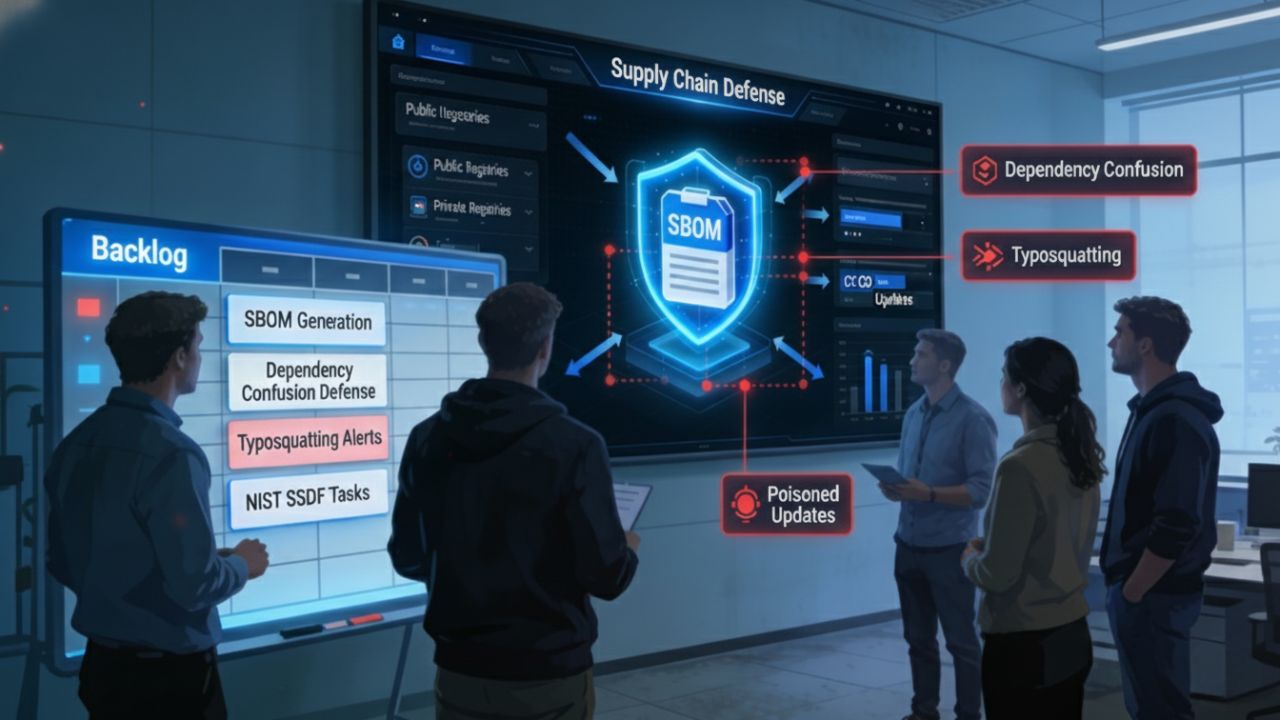
In the modern Agile landscape, your code is only as secure as the libraries you import. Recent high-profile breaches have demonstrated a shift in attacker tactics: rather than attacking your code directly, they are poisoning the software supply chain by injecting malicious code into popular open-source dependencies.
For Scrum teams, managing this third-party risk is no longer optional. Governments and industry regulators are now mandating a Software Bill of Materials (SBOM)—essentially a formal list of ingredients for your software. This guide explores how to integrate software supply chain security tools and SBOMs into your existing backlog without sacrificing velocity.
1. The Anatomy of a Supply Chain Attack
To defend your pipeline, you must understand the methods used to compromise the CI/CD supply chain:
- Dependency Confusion: Attackers upload a malicious package to a public registry with the same name as an internal company package, tricking the build system into pulling the newer public version.
- Typosquatting: Malicious packages are named similarly to popular tools (e.g., node-js instead of nodejs) to catch developer typos.
- Poisoned Updates: Attackers gain access to a legitimate maintainer's account and push a malicious update to a trusted library.
2. Implementing SBOMs in the Backlog
Generating an SBOM should not be a manual audit task. Instead, it should be an automated output of your build process, a core principle of Compliance as Code.
- How to generate a Software Bill of Materials: Use automated tools within your CI/CD pipeline to scan your manifests and generate files in standardized formats like SPDX or CycloneDX.
- SBOM formats: Choose a machine-readable format that allows for automated vulnerability matching against databases like the National Vulnerability Database (NVD).
- Automating dependency updates safely: Use tools that automatically create pull requests for dependency updates, but ensure they are coupled with automated regression tests to prevent breaking changes.
3. Top 5 Software Supply Chain Security Tools
To effectively secure your software artifacts and detect malicious packages in code, consider these industry-standard Software Composition Analysis (SCA) tools:
| Tool | Focus Area | Key Benefit |
|---|---|---|
| Snyk | Open Source Vulnerabilities | Deep integration with developer workflows to find and fix vulnerabilities in real time. |
| Sonatype Nexus | Repository Management | Excellent for preventing dependency confusion and managing local components. |
| GitHub Dependency Graph | Native Integration | Provides automated alerts and Dependabot updates directly within the repository. |
| Anchore | SBOM Generation | Specializes in deep analysis of container images and generating comprehensive SBOMs. |
| Aqua Security | Cloud-Native Supply Chain | Secures the entire pipeline from code to cloud, including SLSA compliance. |
4. NIST Guidelines for Secure Software Development
Adhering to the NIST Secure Software Development Framework (SSDF) is becoming a requirement for many enterprise contracts. Key practices for DevSecOps teams include:
- Verify third-party software: Ensure all components are from trusted sources and have been scanned.
- Protect code integrity: Use digital signatures to ensure that the code built is the same code that is deployed, a concept known as Supply Chain Levels for Software Artifacts (SLSA).
- Continuous monitoring: Vulnerabilities are discovered daily. An SBOM allows you to quickly identify if a newly disclosed bug affects your existing production environment.
FAQ: Supply Chain and SBOMs
What is an SBOM? A formal record containing details and supply chain relationships of various components used in building software.
Why is third-party risk management in DevOps hard? Most modern applications are composed of up to 80% open-source code, creating a massive, often invisible, attack surface.
How do we prevent npm supply chain attacks? Use lock files to pin dependency versions and utilize private registries to curate approved packages.
What is a dependency confusion attack? An exploit where a build system is tricked into downloading a malicious public package instead of a private internal one.
Sources and References
- NIST – Secure Software Development Framework (SSDF) Version 1.1
- CISA – Securing the Software Supply Chain: Recommended Practices Guide
- OpenSSF – Supply-chain Levels for Software Artifacts (SLSA)
- NTIA – The Minimum Elements for a Software Bill of Materials (SBOM)
- Scrum Day India – DevSecOps 2026: The Guide to Secure Agile Delivery (Pillar Page)