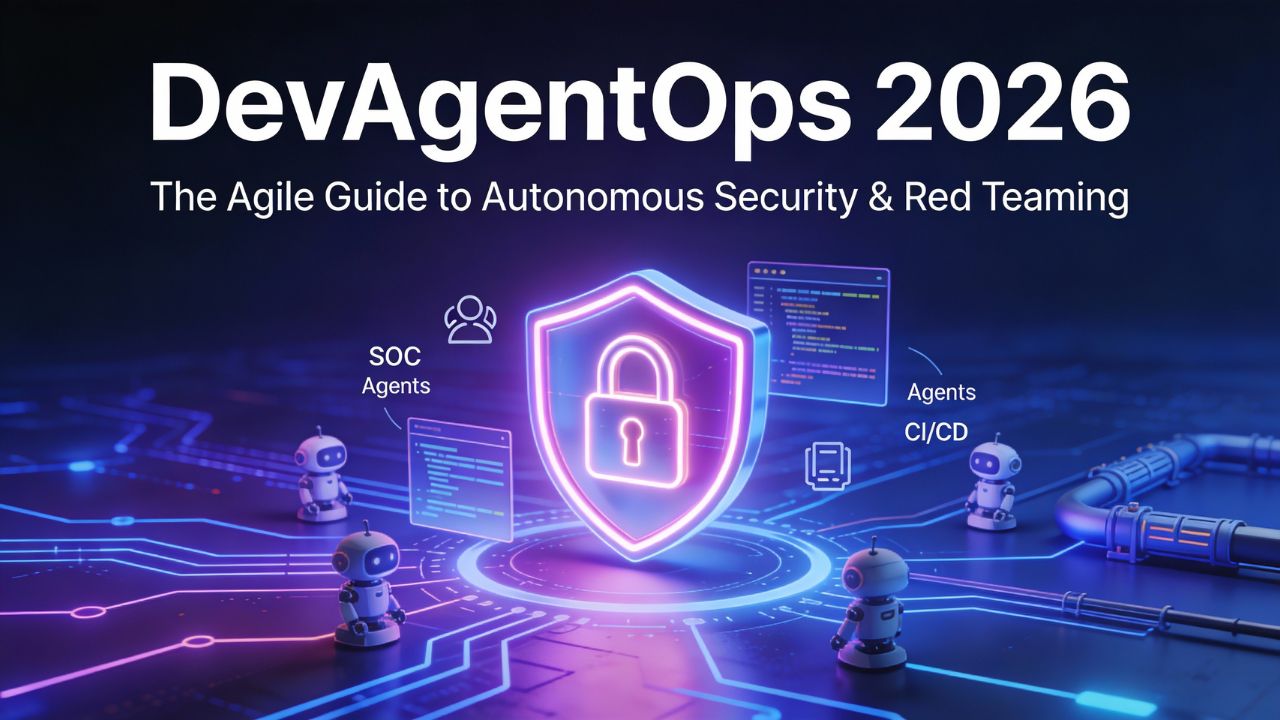
DevAgentOps 2026: The Agile Guide to Autonomous Security & Red Teaming
In 2026, we don't just shift security left—we automate it entirely. The SOC Analyst is now an AI Agent. Humans don't triage alerts anymore; they audit the agents that do. This is the shift from DevSecOps to DevAgentOps.
For the last decade, the goal of DevSecOps was collaboration: breaking down silos between developers and security teams. But as we approach 2026, collaboration is too slow. The volume of AI-generated code, the speed of microservices deployment, and the sophistication of AI-driven attacks have rendered manual security reviews obsolete.
We are entering the era of Autonomous Security Operations, or "DevAgentOps." In this model, AI agents—not humans—perform the bulk of security tasks. They Red Team your code before you commit it, hunt for "Shadow AI" in your network, and patch vulnerabilities in real-time.
For Agile teams, this is a velocity multiplier. Instead of waiting days for a security review, your Definition of Done (DoD) is verified instantly by an agent. However, this power comes with new responsibilities: managing "Security Compute Units" (SCUs) in your budget and governing the non-human identities that now run your pipeline.
Key Concepts for Agile Leaders
- Security Compute Units (SCUs): Security is no longer a fixed cost; it's a consumption model. Just as you estimate Story Points, you must now estimate the SCUs required to secure a feature.
- The Agentic SOC: A security operations center run primarily by autonomous agents that can detect, investigate, and remediate threats without human intervention, escalating only novel issues to human analysts.
- Red Teaming as QA: adversarial testing is no longer a once-a-year event. It is a continuous "unit test" that runs on every pull request.
1. Choosing a Security Copilot for Your Pipeline
Not all AI security agents are created equal. For a DevOps lead, the choice isn't just about detection rates—it's about developer friction. Does the tool slow down your build? Does it integrate natively with GitHub Actions or Jira?
- Microsoft Security Copilot: Best for teams deep in the Azure/GitHub ecosystem. It speaks the language of your developers but charges heavily based on SCU consumption.
- Google Gemini for Security: Ideal for Kubernetes-native shops. It excels at analyzing complex log data and threat intelligence but integrates differently into the SDLC.
- CrowdStrike Charlotte AI: The "agent-based" powerhouse. It lives on the endpoint, offering zero-latency protection but potentially adding overhead to local developer machines.
Read the Full Guide: Choosing a Security Copilot for Your Pipeline
2. Automated Red Teaming: The New "Unit Test"
If you are using AI to write code, you must use AI to break it. "Red Teaming" has historically been a manual, expensive consulting engagement. In 2026, it is an automated phase of your CI/CD pipeline.
We explore how to use tools like PyRIT (Python Risk Identification Tool) and Garak (Generative AI Red-teaming & Assessment Kit) to attack your own applications before they reach production. This section redefines "Red Teaming" from a security activity to a Quality Assurance (QA) activity.
- The Strategy: "If your AI feature hasn't been Red Teamed by Garak, it isn't 'Done'."
- New Tools: Why Promptfoo is becoming the standard for deterministic LLM testing in regression suites.
Read the Full Guide: Automated Red Teaming for Agile Teams
3. Shadow AI & OAuth Worms: Managing Identity Risk
Velocity loves automation, but automation creates "Shadow Agents." These are unauthorized AI bots or service accounts that developers spin up to solve a problem but never decommission. By 2026, these "Non-Human Identities" will outnumber humans 50:1.
The risk? OAuth Worms. Malicious agents that spread through SaaS ecosystems by granting themselves permission to read your repositories, Slack channels, and databases. This section guides Product Owners on how to audit "OAuth permissions" during Sprint Planning and treat "Identity Debt" as seriously as Technical Debt.
Read the Full Guide: Managing Shadow AI & Non-Human Identities
4. Designing the 2026 Sprint: Integrating Agentic Security
How do you fit all this into a 2-week Sprint without exploding the workload? You update your ceremonies. This guide provides a practical workflow for the modern Scrum Master.
- Sprint Planning: Add a line item for "Security Compute" budget. If a feature is AI-heavy, does it require extra SCUs for Red Teaming?
- Daily Standup: Treat the AI Security Agent as a team member. Did it flag any blockers overnight?
- Sprint Review: Don't just demo the feature; demo the safety of the feature. Show the "Red Team Report" alongside the product increment.
- Retrospective: Analyze "False Positives." If the security agent blocked a valid deployment, discuss how to tune the agent for the next Sprint.
Read the Full Guide: Integrating Agentic Security into Scrum
FAQ: DevAgentOps & Agile Security
Q: What is the difference between DevSecOps and DevAgentOps?
A: DevSecOps focuses on human collaboration—developers and security pros working together. DevAgentOps focuses on human-agent supervision—developers building features while autonomous AI agents handle the security testing, monitoring, and remediation in the background.
Q: What is a Security Compute Unit (SCU)?
A: An SCU is a unit of measure for the processing power required to run AI security workloads. Vendors like Microsoft use this to price their Security Copilot services. In Agile, teams must budget for SCUs just like they budget for cloud infrastructure costs.
Q: Will AI agents replace the Security Champion role in Scrum teams?
A: No. The role will evolve. Instead of manually reviewing code, the Security Champion will become the "Agent Architect"—responsible for configuring the AI agents, defining their rules of engagement, and auditing their decisions.
Q: What is an OAuth Worm?
A: An OAuth Worm is a type of cyberattack where a malicious autonomous agent uses OAuth token permissions to move laterally across SaaS applications (e.g., from GitHub to Slack to Salesforce) without stealing passwords, often spreading automatically.
Sources and References
- 5 Non-Human Identity Risks That Will Derail Your Velocity in 2026 – Scrum Day India
- Securing AI-Generated Code: A Guide for Agile Teams – Scrum Day India
- DevSecOps 2026: The Guide to Secure Agile Delivery – Scrum Day India
- Microsoft Security Copilot Overview
- OWASP Top 10 for LLM