5 Non-Human Identity Risks That Will Derail Your Velocity in 2026
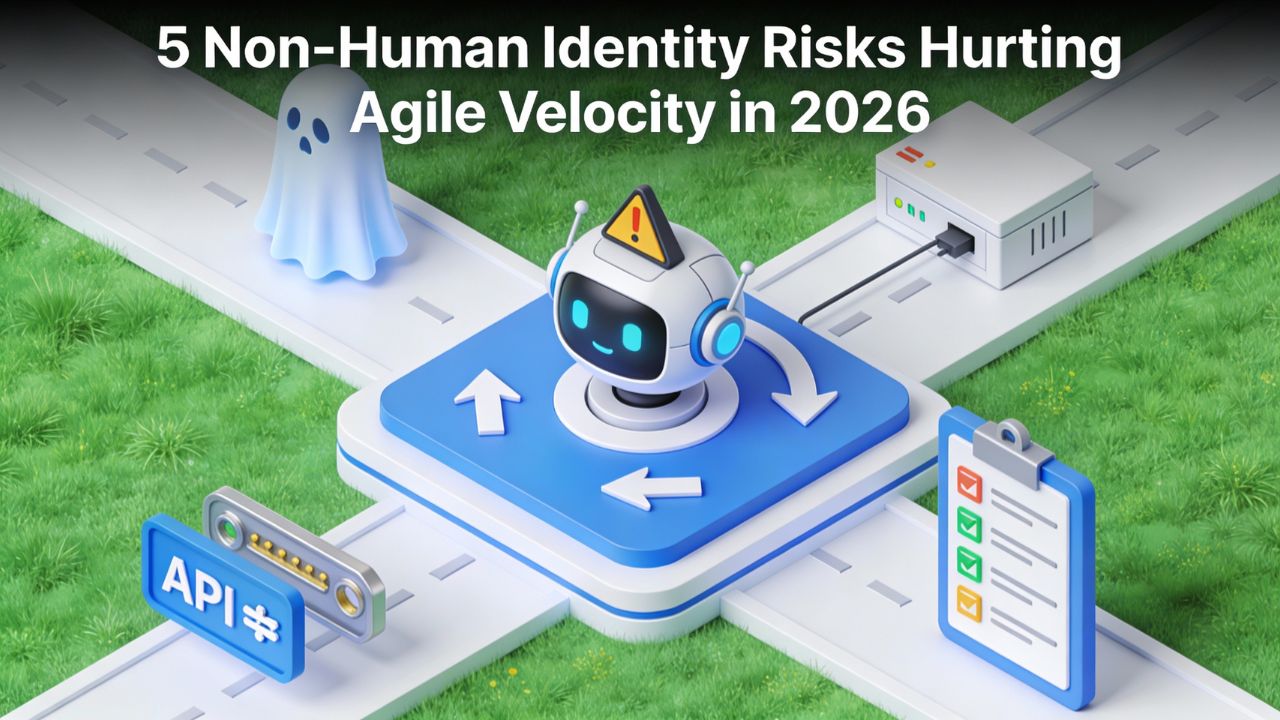
1. The Looming Crisis: Machines Outnumber Humans
By 2026, the ratio of non-human identities (bots, service accounts, and API keys) to human users is expected to reach 45:1. While human identity security has matured with MFA and SSO, machine identities remain the "dark matter" of the enterprise—vast, unmanaged, and highly privileged. For Agile teams, these identities are the engines of velocity, but their mismanagement creates a silent secondary perimeter that is easily breached.
2. The 5 Critical Risks
Risk 1: Agentic AI & Autonomous Bot Sprawl
As teams integrate "Agentic AI" to write and deploy code, these autonomous agents require high-level permissions. If an AI agent's identity is not scoped with "Least Privilege," a single prompt injection or logic error could allow the bot to delete production environments or leak entire databases. This is a critical factor when securing AI-generated code.
Risk 2: The "Secret Sprawl" in Microservices
Microservices architecture relies on constant API communication. When developers hardcode API keys or use "long-lived" tokens to maintain velocity, they create a permanent trail of breadcrumbs for attackers. Securing these requires moving toward dynamic, short-lived credentials.
Risk 3: Supply Chain Poisoning via Service Accounts
Non-human identities are the primary vector for modern supply chain breaches. If a third-party CI/CD plugin has over-privileged access to your repository via an OAuth token, an upstream compromise of that plugin gives attackers a direct back-door into your "Done" increments. Teams must focus on stopping supply chain attacks by auditing these bot identities.
Risk 4: Shadow "Ghost" Identities
When a microservice is decommissioned but its service account or API key is not revoked, it becomes a "Ghost Identity." These unmonitored credentials are gold mines for attackers because their activity rarely triggers security alerts.
Risk 5: Lack of "Non-Human" Governance
Most Scrum teams have a process for offboarding employees but no process for offboarding "orphaned" code-based identities. Without a lifecycle management policy for machines, technical debt turns into a security catastrophe.
3. [How-To] 3 Steps to Mitigate Machine Risk
Step 1: Discover & Map
Task: Use automated discovery tools to find every service account, secret, and bot in your environment. Agile Action: Ensure all non-human identities are tagged with a specific Scrum Team owner in your identity registry.
Step 2: Implement Workload Identity Federation
Task: Remove long-lived secrets. Use "Identity Federation" to allow machines to trust each other based on short-lived tokens. Agile Action: This aligns with the "Verify Explicitly" pillar of Zero Trust for Remote Scrum Teams.
Step 3: Automated Secret Scanning
Task: Integrate scanning into every Git push to prevent non-human credentials from entering the codebase. Agile Action: This is a mandatory step for securing AI-generated code.
4. Non-Human Identity Security: The 2026 Toolset
| Tool Type | Rotation Mechanism | Impact on Velocity |
|---|---|---|
| Secrets Managers (Vault/Conjur) | Dynamic secret generation for apps. | High: Removes the need for manual key management. |
| Machine Identity Management (MIM) | Certificate automation and lifecycle tracking. | Medium: Requires initial setup but automates renewals. |
| Cloud Entitlement (CIEM) | Analyzes "over-privileged" bot accounts. | High: Reduces the attack surface without breaking code. |
5. Why Scrum Teams Must Care
Ignoring non-human identity risk is no longer just a security issue; it is a velocity issue.
- Prevents "Stop-the-Line" Events: A leaked bot token can lead to total environment lockout.
- Ensures Compliance: Automated audits for 2026 require proof of non-human identity governance.
- Protects AI Innovation: You cannot safely use AI in DevOps without securing the identities those agents use.
FAQ Section
What is a "Non-Human Identity"?
It is any entity that is not a person—service accounts, API keys, bots, AI agents, and automated scripts—that requires access to data or systems.
Does rotating machine keys break automation?
Only if done manually. Modern tools use "Dynamic Secrets" where the application automatically requests a new key when the old one expires, ensuring zero downtime.