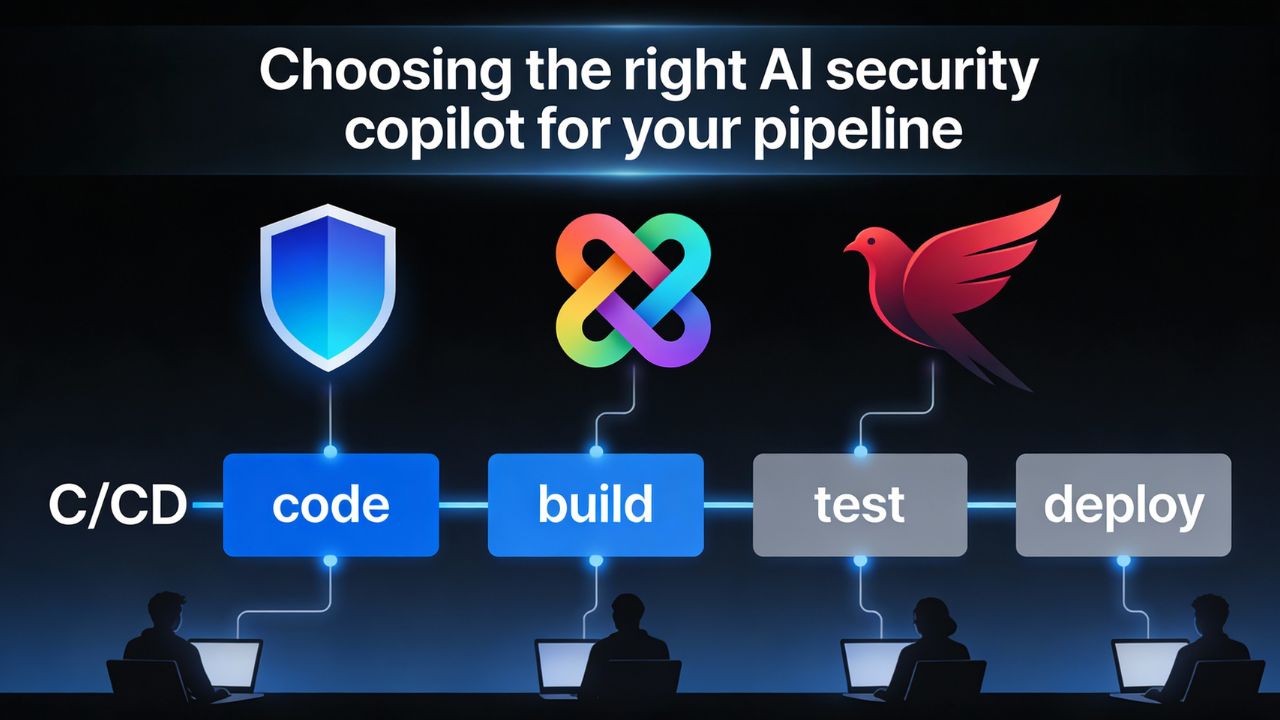
Choosing a Security Copilot for Your Pipeline: Microsoft vs. Google vs. CrowdStrike in CI/CD
Not all AI security agents are created equal. For a DevOps lead, the choice is less about raw detection rates and more about developer friction, CI/CD fit, and how fast incidents move from alert to fix.
This guide compares Microsoft Security Copilot, Google Gemini, and CrowdStrike Charlotte AI specifically in the context of GitHub Actions, Kubernetes-native workflows, and endpoint-heavy pipelines so you can pick the right copilot for your delivery stack.
Why CI/CD Integration Matters More Than Features
Most teams already drown in security findings; another dashboard does not help unless it plugs into existing boards, repos, and alert routes with minimal friction.
The right copilot should be able to read from your work items, comment on pull requests, and trigger remediation workflows without adding minutes to every build or requiring developers to context switch into a separate console.
Copilot Toolset: Integration and Developer Experience
The table below mirrors the DevAgentOps toolset style and focuses on how each AI assistant behaves inside a real CI/CD pipeline, not just in marketing diagrams.
| Tool | Best Fit | CI/CD & Work Tracking Integration | Developer Experience & MTTR Impact |
|---|---|---|---|
|
Microsoft Security Copilot Azure + GitHub |
Teams deep in Azure, GitHub, and Microsoft 365 security tooling. | Links GitHub pull requests and branches to Azure Boards work items, letting the Copilot coding agent generate branches and draft PRs directly from backlog items with full traceability. | Reduces context switching for developers because discussions stay in GitHub and Boards, but heavy use can consume Security Copilot capacity units, so pipelines must budget scans per Story. |
|
Google Gemini for Security Kubernetes-native |
Cloud‑native shops built on GKE, Cloud Run, and Kubernetes‑first architectures. | Gemini Cloud Assist and Gemini CLI extensions analyze GKE clusters, logs, and CI/CD deployments; the security extension can run `/security:analyze` on diffs locally and in pipelines, with GitHub Actions integration on the roadmap. | Fits neatly into kubectl and gcloud workflows and can suggest fixes inline, but early CI/CD integrations may require more scripting effort compared to Microsoft’s Boards integration. |
|
CrowdStrike Charlotte AI Endpoint-first |
Organizations standardizing on Falcon agents across servers, laptops, and cloud workloads. | Operates through the Falcon platform and Fusion automation; CI/CD hooks typically come from forwarding build and runtime telemetry into Falcon rather than native Actions steps or build tasks. | Provides near real‑time triage on developer and build agents with high detection accuracy, cutting manual triage hours and MTTR, but may add overhead to local machines if policies are overly aggressive. |
Microsoft Security Copilot: Native GitHub and Azure Boards Powerhouse
For teams already using GitHub, Entra ID, Defender, and Azure Boards, Microsoft Security Copilot feels like an extension of existing workflows rather than a new product.
Work items in Azure Boards can now invoke a Copilot coding agent that generates a branch and draft pull request, keeps status in sync, and links commits back to the Story, which is ideal when Scrum teams want traceable, automated fixes for security bugs.
The trade‑off is consumption: Security Copilot uses capacity units, so security leaders must treat automated triage and code suggestions as part of an SCU budget the same way they budget cloud compute for tests.
Where It Shines in CI/CD
- GitHub-centric pipelines using Actions and Advanced Security can surface alerts and Copilot suggestions directly in pull requests and security views.
- Azure Boards integration allows Sprints to be planned around “fix this with Copilot” tasks that move seamlessly from backlog to PR without extra glue code.
- Security teams can combine Defender, Sentinel, and Security Copilot telemetry, giving Copilot richer context when proposing remediation steps.
Google Gemini: AI for Kubernetes‑Native Pipelines
Google Gemini focuses on using contextual project information from GKE, Cloud Operations, and Cloud Run to recommend changes and troubleshoot production issues, which suits teams running microservices at scale.
Gemini Cloud Assist can answer questions about cluster health, suggest configuration changes, and generate IaC snippets, while the Gemini CLI adds `/deploy` and security analysis commands that plug into modern Git-based workflows.
Early CI/CD security integrations rely on the Gemini CLI security extension and custom pipeline jobs, so DevOps engineers should expect to write some glue for GitHub Actions, Cloud Build, or GitLab until first‑class plugins mature.
Where It Shines in CI/CD
- GKE-based teams can ask Gemini why a rollout is failing or how to optimize resource usage and apply the suggested YAML patch directly to their manifests.
- The Gemini CLI security extension can analyze diffs and flag secrets, injections, and access‑control issues as part of pre‑commit or pipeline stages.
- Gemini Enterprise offers controls such as VPC Service Controls and customer‑managed keys, which matter when security copilots touch production telemetry.
CrowdStrike Charlotte AI: Agent‑Based Analyst for Pipelines
CrowdStrike Charlotte AI is designed as an AI analyst that sits on top of the Falcon platform, using years of triage data and Threat Graph telemetry to prioritize alerts and recommend responses at machine speed.
Charlotte AI’s strength is high‑accuracy triage and automation through Falcon Fusion playbooks, which can noticeably reduce mean time to respond when build agents and production nodes already run Falcon.
Because it is endpoint‑centric, the CI/CD story revolves around how much telemetry from developer laptops, build runners, and ephemeral containers is sent into Falcon, and how aggressive detection policies are during development.
Where It Shines in CI/CD
- Agent coverage across laptops and build servers allows Charlotte AI to catch and triage malware or lateral‑movement attempts affecting developer environments.
- Falcon Fusion workflows can automate containment actions, ticket creation, and notifications once Charlotte AI labels an alert as high priority.
- By eliminating large volumes of low‑value alerts, Charlotte AI frees SOC and platform engineers to focus on systemic hardening and pipeline improvements.
How to Pick the Right Security Copilot for Your Pipeline
If your Sprints already revolve around Azure Boards and GitHub, starting with Microsoft Security Copilot minimizes integration work and gives the cleanest story for traceable, automated security fixes.
Kubernetes‑heavy teams that lean on GKE and Cloud Run gain more from Gemini’s deep understanding of cluster state and cloud resources, while CrowdStrike customers with broad Falcon coverage may get the fastest MTTR gains from Charlotte AI triage.
The pragmatic approach is to pilot one copilot per ecosystem: Copilot for code and backlog, Gemini for cloud infrastructure, and Charlotte AI for runtime triage, then watch where developer friction and incident timelines actually improve.
Already working on DevAgentOps? Read the related guide: DevAgentOps 2026 – The Agile Guide to Autonomous Security and Red Teaming .
Related DevSecOps and Cloud Security Articles
Sources and References
- Microsoft Learn – Use GitHub Copilot with Azure Boards
- Azure DevOps Blog – Azure Boards integration with GitHub Copilot
- GitHub – Azure/Security-Copilot repository
- Microsoft Azure – GitHub Copilot product overview
- Microsoft Learn – Azure Boards integration with GitHub
- Google Cloud – Fine‑tune GKE services with Gemini assistance
- Google Cloud Blog – Automate app deployment and security analysis with Gemini CLI
- Google Cloud – Gemini Enterprise overview
- CrowdStrike – Charlotte AI: Agentic Analyst for Cybersecurity
- CrowdStrike Press – Charlotte AI Detection Triage announcement
- Cybersecurity Asia – Charlotte AI detection and triage analysis
- CrowdStrike – What is CI/CD?
FAQ: Selecting a Security Copilot
Q: Which AI security copilot is best for GitHub Actions and Azure DevOps?
A: Microsoft Security Copilot combined with GitHub Copilot and Azure Boards offers the deepest native integration for GitHub-centric CI/CD. Work items can trigger Copilot coding agents that create branches and draft pull requests, while GitHub Actions and Defender alerts feed context into Copilot for remediation suggestions.
Q: When should a DevOps team choose Google Gemini for security?
A: Gemini fits best in Kubernetes-native shops on Google Cloud. Gemini Cloud Assist understands GKE clusters and Cloud Run deployments, while the Gemini CLI and its security extension can analyze code diffs and deployments as part of CI/CD jobs.
Q: Does CrowdStrike Charlotte AI slow down developer machines?
A: Charlotte AI runs on top of Falcon agents that already protect endpoints. In most cases, it improves efficiency by automating triage in the Falcon backend rather than adding heavy local scanning, but aggressive policies or extensive telemetry collection can add some overhead on build servers and developer laptops.
Q: How do these copilots help reduce MTTR in CI/CD?
A: All three tools reduce mean time to respond by automating parts of detection and triage. Security Copilot links alerts to work items and pull requests, Gemini analyzes cloud-native deployments and suggests fixes, and Charlotte AI prioritizes and responds to Falcon detections using automated playbooks.