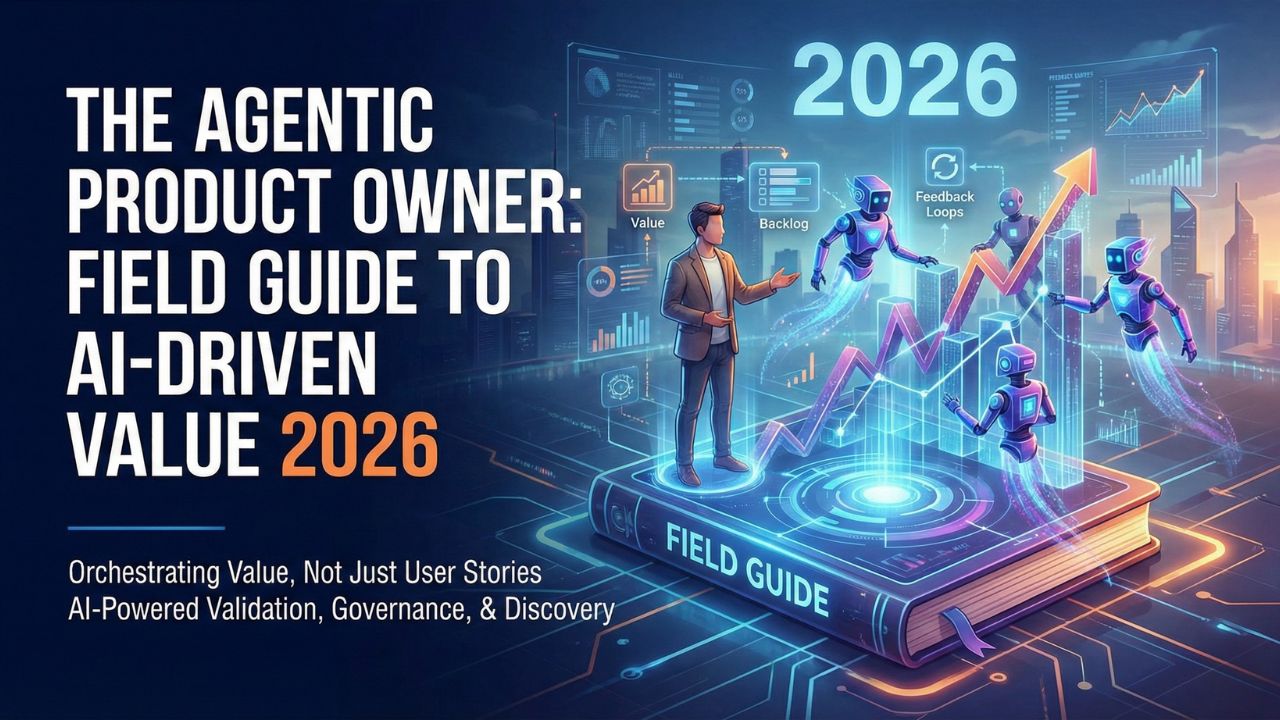
The Agentic Product Owner: A Field Guide to AI-Driven Value Discovery in 2026
By late 2025, the industry realized that using Generative AI merely to "write better user stories" was a failure of imagination. We were using a Ferrari to plow a field. In 2026, the Product Owner (PO) role is undergoing its most radical shift since the publication of the Agile Manifesto. We are no longer just prioritizing backlogs; we are orchestrating value agents.
This field guide explores the transition to Agentic Product Ownership—where AI doesn't just assist you; it actively interacts with your product environment, verifies requirements, and simulates user feedback before a single line of code is written.
1. From User Stories to "Prompt Chains"
The traditional format—"As a user, I want X, so that Y"—is becoming a legacy artifact. While useful for human alignment, it is insufficient for the AI agents now responsible for generating code and tests.
The Shift to Agent Directives
The Agentic PO manages "Prompt Chains" rather than static Jira tickets. A prompt chain is a series of executable instructions that guide an AI agent to:
- Contextualize: Ingest the product vision and architectural constraints.
- Generate: Draft the feature specifications.
- Critique: Self-correct against historical data and brand guidelines.
Example: The Hardware Switch
Consider a backlog item for a physical electric switch. Instead of writing a static story, the Agentic PO issues a directive:
"Agent, analyze the safety compliance standards for residential switches in the EU market. Generate acceptance criteria that satisfy IEC 60669-1 and draft a test plan for the firmware team."
This shifts the PO's focus from typing requirements to reviewing high-fidelity outputs generated by agents.
2. Managing "Synthetic Stakeholders"
One of the biggest bottlenecks in Scrum has always been the feedback loop. Waiting two weeks for a Sprint Review to hear stakeholders say, "That’s not what I wanted," is too slow for 2026.
Simulating Feedback Loops
We now utilize Synthetic Stakeholders—AI personas trained on customer data, behavioral analytics, and user interviews. These personas allow the PO to "Red Team" the backlog for User Experience (UX) risks instantly.
- The Skeptic Persona: Analyzes the backlog for edge cases and security flaws.
- The Novice Persona: Flags features that are too complex or lack intuitive UI flows.
- The Power User Persona: Demands keyboard shortcuts and advanced API access.
By running requirements through these synthetic personas, the PO creates a Definition of Ready (DoR) powered by AI validation. A story is not "Ready" until the synthetic users have signed off on the proposed logic.
3. Automated Governance: Compliance as Code
In the past, compliance was a "tax" paid at the end of the release cycle. Today, it is an upfront input. Agentic Product Ownership involves integrating Compliance as Code directly into the backlog refinement process.
Security agents now scan the backlog in real-time. If a PO suggests a feature that captures PII (Personally Identifiable Information), the agent immediately flags it for GDPR or HIPAA compliance requirements. This ensures that regulatory hurdles are cleared before the Sprint Planning event, preventing "Carry Over" caused by last-minute legal blocks.
4. Metrics 2.0: Value Realization over Velocity
For years, we obsessed over Velocity—a metric of output (how much did we build?). In the agentic era, velocity is easily manipulated and increasingly irrelevant. If an AI writes the code, does "story points per sprint" still matter?
The Agentic PO focuses on Value Realization. We use predictive analytics to measure the outcome of a backlog item. We ask: "What is the probability this feature increases retention by 5%?". Agents analyze similar past features and market trends to assign a "Value Probability Score" to every item in the backlog.
5. The Tooling Landscape: Jira vs. The Agents
The tools we use are changing. We are seeing a divergence between traditional "Passive Backlogs" (like Jira or Azure DevOps) and "Active Agentic Platforms".
- Traditional Tools: Great for logging what happened.
- Agentic Platforms: Great for predicting what should happen.
The best Product Owners in 2026 are learning to integrate these worlds—using agents to populate and maintain the rigorous documentation required by enterprise tools, while using agile, chat-based interfaces for the actual creative work of product discovery.
Ready to lead in 2026? Check out the AI Product Owner Certification Course.
FAQ: Agentic Product Ownership
Q: Will AI replace the Product Owner?
A: No, but it will replace Product Owners who refuse to use AI. The role is shifting from "tactical writer" to "strategic editor." You will spend less time in Jira and more time talking to customers and training your agents.
Q: What is a "Synthetic Stakeholder"?
A: It is an AI model configured to mimic the biases, needs, and behaviors of a specific user segment. It allows you to test hypotheses instantly without waiting for human focus groups.
Q: How does AI impact the Definition of Done (DoD)?
A: AI impacts the Definition of Ready (DoR) by validating requirements upfront. However, it also aids the DoD by automatically generating release notes, updating documentation, and verifying that "Compliance as Code" checks have passed.
Q: Do I need to know how to code to be an Agentic PO?
A: You don't need to code in Java or Python, but you do need to master Prompt Engineering and understand system architecture well enough to guide the agents effectively.
Sources and References
- Shadow AI & OAuth Worms: Managing Non-Human Identity Risks in the Backlog – Scrum Day India (2025)
- Designing the 2026 Sprint: Integrating Agentic Security into Scrum Events – Scrum Day India (2025)
- From User Stories to Agent Directives: Updating the Hardware Example – Agentic Product Ownership Hub (2026)
- Synthetic Users & Red Teaming for UX – Agentic Product Ownership Hub (2026)
- Automated Governance: The PO’s Guide to Compliance-as-Code – Agentic Product Ownership Hub (2026)