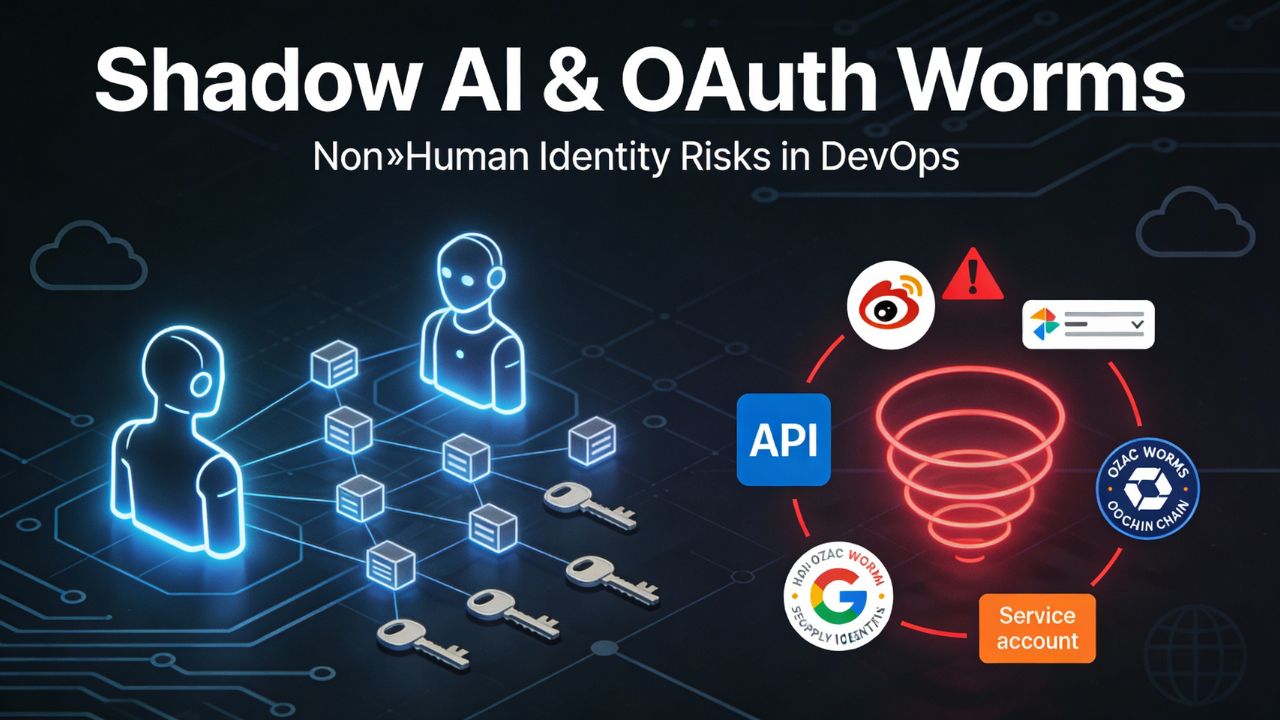
Shadow AI & OAuth Worms: Managing Non-Human Identity Risks in the Backlog
By 2026, non-human identities will outnumber humans 45:1. While human identity security has matured with MFA and SSO, machine identities remain the "dark matter" of the enterprise—vast, unmanaged, and highly privileged. For Agile teams, ignoring machine identity risk is no longer just a security issue; it is a velocity issue.
Non-human identities (bots, service accounts, API keys) power your velocity but create a silent secondary perimeter that attackers exploit. These "ghost identities" operate without oversight, often with god-level permissions.
2026 Reality: 45 non-human identities for every human user. Most over-privileged, many orphaned, and rarely governed.
The 5 Critical Non-Human Identity Risks
Risk 1: Agentic AI & Autonomous Bot Sprawl
AI agents that write and deploy code often run with broad permissions, so a single prompt injection or logic bug can delete environments, leak data, or self-escalate access.
- Compromised agent can undo a Sprint’s work in minutes.
- Over-privileged bot accounts are hard to trace back to owners.
- Lack of least privilege makes blast radius unpredictable.
Risk 2: Secret Sprawl in Microservices
Microservices rely on constant API communication, and hardcoded API keys or long-lived tokens leave a permanent breadcrumb trail for attackers.
- Static keys in code and config are difficult to rotate safely.
- Technical debt around secrets delays future Sprints.
- One leaked token can compromise multiple services.
Risk 3: Supply Chain Poisoning via OAuth
Third-party CI/CD plugins often hold over-privileged OAuth tokens to your repos, so an upstream compromise can push malicious code straight into main. Attack Flow: Compromised plugin → abused OAuth token → malicious commit to main → local gates bypassed entirely.
Risk 4: Shadow "Ghost" Identities
When services are decommissioned but their service accounts or API keys are not revoked, they become ghost identities with lingering access.
- Rarely monitored, so attacker use is hard to spot.
- Ownership unclear, so nobody feels responsible.
- Access may persist to production and critical systems.
Risk 5: No Non-Human Governance
Most teams have clear human offboarding but no lifecycle for bots and service accounts, turning technical debt into a security and compliance problem. Missing governance leads to failed audits and escalating incidents as unmanaged identities accumulate.
Quick Reference: Non-Human Identity Risk Map
| Risk | Root Cause | Agile Impact | Fix Priority |
|---|---|---|---|
| Agentic AI Sprawl | Over-privileged autonomous agents | Sprint-killing incidents | Highest |
| Secret Sprawl | Hardcoded, long-lived secrets | Growing technical debt | High |
| OAuth Worms | Over-privileged supply-chain tokens | Security gates bypassed | Highest |
| Ghost Identities | Unrevoked legacy accounts | Persistent backdoors | High |
| No Governance | No lifecycle or ownership | Audit and incident risk | Medium |
[How-To] 3 Steps to Secure Non-Human Identities
Step 1: Discover & Map
Use automated discovery tools to find every service account, secret, and bot, then tag each with a specific Scrum team owner in your registry.
- Cloud-native analyzers (AWS IAM Analyzer, GCP auditors, Azure reviews).
- CIEM tools to surface over-privileged identities.
- Secret scanners across code and pipelines.
Outcome: A complete inventory with clear accountability.
Step 2: Implement Workload Identity Federation
Replace long-lived secrets with short-lived tokens issued via identity federation so machines trust each other without static passwords. Platforms include AWS SigV4, GCP Workload Identity Federation, Azure Managed Identity, and HashiCorp Vault with JWT/OIDC.
Outcome: Eliminates static secrets and shrinks blast radius if a token leaks.
Step 3: Automated Secret Scanning
Integrate secret scanning into every Git push, using pre-commit hooks, CI/CD checks, and repository sweeps to keep credentials out of code. Use tools like GitGuardian, TruffleHog, GitHub, and GitLab secret scanning.
Outcome: Blocks commits containing secrets and fails builds when scans detect exposure.
2026 Non-Human Identity Toolset
| Tool Type | Core Function | Velocity Impact |
|---|---|---|
| Secrets Managers (Vault / Conjur) | Dynamic secret generation and rotation | High: Removes manual key management. |
| Machine Identity Management (MIM) | Certificate issuance and lifecycle tracking | Medium: Initial setup, then fewer outages. |
| Cloud Entitlement (CIEM) | Finds over-privileged human and bot identities | High: Shrinks attack surface without refactoring. |
| Workload Identity Platforms | Federated identities and ephemeral tokens | High: Zero secrets in code speeds onboarding. |
| Secret Scanning & Policy-as-Code | Detects leaked secrets and misconfigurations | Medium: Early detection prevents incidents. |
Why Scrum Teams Must Care
Ignoring non-human identities creates stop-the-line events where leaked tokens force environment lockdowns and halt delivery.
- Prevents outages: Better hygiene means fewer catastrophic leaks.
- Enables compliance: Modern audits expect proof of machine identity governance.
- Protects AI innovation: Secure identities are prerequisite for safe Agentic AI in DevOps.
FAQ: Non-Human Identity Governance
What is a "Non-Human Identity"?
A non-human identity is any entity that is not a person but needs access to systems, such as service accounts, API keys, bots, AI agents, scripts, and certificates.
Does rotating machine keys break automation?
Not when using dynamic secrets, where applications automatically request new credentials as old ones expire, avoiding downtime and manual changes.
How often should we rotate service account credentials?
Short-lived federated credentials should rotate every 15 minutes to 1 hour, medium-lived secrets every 30–90 days, and certificates annually or before expiry, ideally via automation.
Which comes first: governance or tooling?
Governance comes first: discover identities, tag owners, define lifecycle policies, and then automate with tools to avoid scaling bad practices.
What happens if we find a "ghost identity"?
Triage its access and usage, decommission if unused for 90 days, or assign an owner and govern it properly if still active, avoiding immediate deletion that might break production.