From User Stories to Agent Directives: Updating the Hardware Example
In 2026, the era of spending hours debating the phrasing of a "As a user..." card is over. For the Agentic Product Owner, requirements engineering has shifted from manual documentation to the creation of executable specifications.
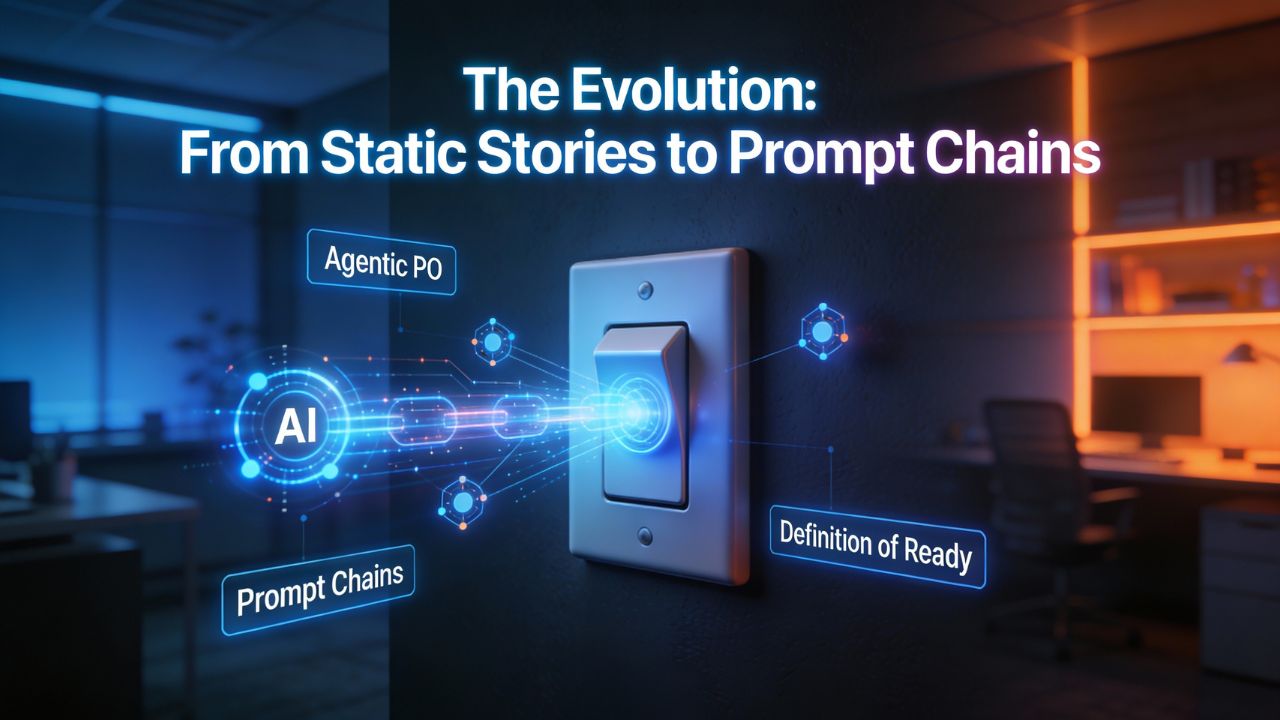
The Evolution: From Static Stories to Prompt Chains
The traditional user story was designed for human alignment. While it served its purpose in the early 2020s, it is insufficient for a world where AI agents generate code, tests, and compliance documentation.
- Contextualize: The agent ingests the overall product vision and architectural constraints.
- Generate: The agent drafts detailed feature specifications and acceptance criteria.
- Critique: The agent self-corrects by testing its own output against brand guidelines.
Case Study: The Smart Electric Switch
| Aspect | Traditional User Story (2020) | Agent Directive (2026) |
|---|---|---|
| Input | "As a homeowner, I want a physical switch to toggle my lights so I can control my environment." | "Agent, analyze EU safety standards for residential switches. Generate criteria satisfying IEC 60669-1." |
| Output | Manual acceptance criteria and a few lines of functional requirements. | Automated generation of firmware test plans and compliance checks. |
| Verification | Human review during Sprint Planning sessions. | AI-driven "Red Teaming" against safety and edge-case personas. |
The New "Definition of Ready" (DoR)
In an agentic workflow, a backlog item is not "Ready" just because it is clearly written. The AI-Powered DoR now requires:
- Synthetic Sign-off: Requirements must be validated by Synthetic Stakeholders (AI personas like the skeptic or the novice).
- Compliance-as-Code: Security agents must scan and auto-inject necessary compliance stories (GDPR, HIPAA).
- Value Probability Score: Agents assign a score based on the probability of achieving the desired business outcome.
FAQ: Requirements Engineering with Agents
Q: Does this mean I need to be a developer to write requirements?
A: No. You don't need to code in Python or Java, but you must master Prompt Engineering and understand system architecture well enough to guide the agents effectively.
Q: How do agents handle conflicting requirements?
A: Agents use multi-agent orchestration to simulate conflicts. One agent acts as a "Red Team" to find flaws, while another acts as the "Architect" to resolve them.