Facilitating the Hybrid Team: Conflict Resolution Between Humans and AI Agents
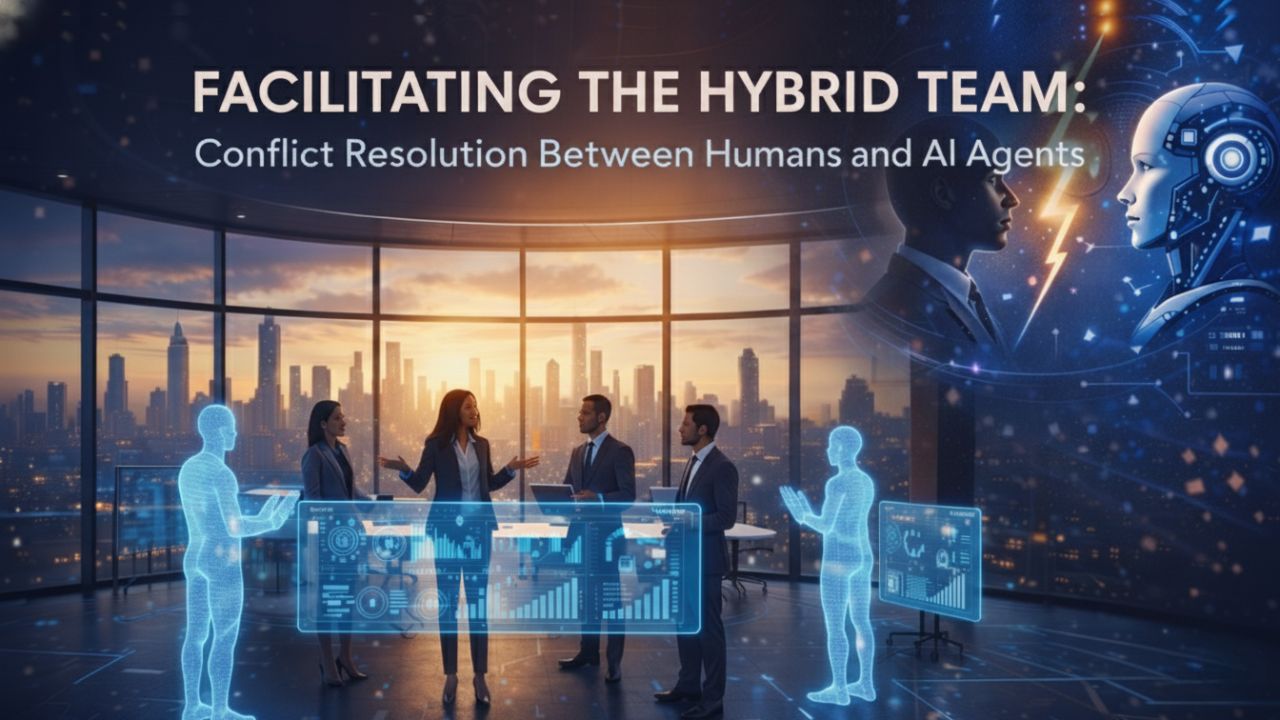
By 2026, the composition of a high-performing Scrum Team has undergone a tectonic shift. While the 2020 Scrum Guide defined teams of humans, the "Cognitive Agile Enterprise" now operates through hybrid squads where synthetic team members—AI agents—handle the mechanics of delivery with terrifying speed.
This evolution has birthed a new frontier for the Scrum Master: Cognitive Friction. Conflict resolution is no longer strictly interpersonal; it is a complex mediation between high-velocity algorithmic output and nuanced human judgment.
The Anatomy of Human-AI Conflict
In a traditional setting, conflict usually stems from differing technical opinions or personality clashes. In a hybrid team, friction emerges from the velocity gap and the intent gap.
1. The Velocity Gap: "The Relentless Peer"
AI agents do not sleep, do not feel fatigue, and can generate code, test cases, and documentation at near-zero cost. When a human developer returns to their desk to find an AI agent has refactored their entire module and generated fifty new pull requests, the result isn't "efficiency"—it’s a threat to psychological safety.
- The Conflict: Humans feel "judged" or "outpaced" by the synthetic member, leading to defensive behavior or burnout.
- The Analogy: Imagine playing a game of chess where your partner is a supercomputer. Even if you are on the same team, the speed at which the computer suggests moves can make your own contributions feel obsolete, leading you to stop trying altogether.
2. The Intent Gap: "The Malicious Compliance"
AI is a master of syntax but a novice of context. Friction occurs when an AI agent generates code that passes all functional tests but violates subtle, unwritten human principles—such as a specific UX "feel" or a long-term architectural vision that hasn't been encoded into a prompt yet.
- The Conflict: A human developer pushes back on "technically correct" AI code. The AI, lacking ego but following strict logic, may continue to suggest the same "correct" solution in subsequent iterations.
- The Analogy: It’s like a master chef (Human) working with a high-speed dicing robot (AI). The robot cuts the onions perfectly to the millimeter, but the chef knows that for this specific sauce, the onions need to be hand-torn for texture. The robot doesn’t understand "texture"—it only understands "size".
New Scrum Master Skills for 2026: Debugging Friction
To facilitate these teams, the Scrum Master must transition from a process guide to a Human-Agent Mediator.
Psychological Safety with Synthetic Members
The Scrum Master must ensure that the presence of AI does not erode the team's trust. This involves setting "engagement rules" for AI. For example, AI agents might be restricted from auto-merging code without a human "vibe check," ensuring that the human team members remain the ultimate arbiters of value.
From Interpersonal Mediation to Prompt Debugging
Traditional mediation involves "I" statements and active listening. Hybrid mediation involves Prompt Debugging. When a human and an AI agent collide, the Scrum Master facilitates a session to clarify Acceptance Criteria. If the AI is "misbehaving," the solution isn't a performance review; it’s a refinement of the team's shared values and how those values are translated into the AI’s instructions.
Managing Cognitive Friction
Cognitive friction occurs when the mental effort to "correct" or "review" AI work exceeds the effort it would have taken to do the work manually. The Scrum Master monitors this weight. If the human developers are drowning in "Reviewer's Fatigue," the Scrum Master must intervene to slow the AI’s velocity to a sustainable pace.
Frequently Asked Questions (FAQ)
How do you handle conflict between a human and an AI agent?
Conflict resolution in hybrid teams often involves "prompt debugging" and clarifying acceptance criteria rather than interpersonal mediation. The Scrum Master ensures humans don't feel "judged" by the AI's output and that the AI aligns with the team's shared values.
What is "Cognitive Friction" in a Scrum Team?
It is the friction between high-speed AI agents and human judgment. It occurs when the volume of AI-generated content overwhelms the human ability to provide meaningful oversight, leading to a breakdown in collaboration.
Does an AI agent have a "personality" in conflict?
While AI lacks feelings, its "persona" is dictated by its training and prompts. Friction often arises because the AI is too literal. The Scrum Master’s job is to help the human team "re-tune" the AI to better fit the team's working style.
How do we maintain psychological safety when half the team never sleeps?
By establishing "Human-in-the-Loop" governance. This ensures that AI is viewed as a tool that accelerates human potential rather than a replacement that creates a "race to the bottom" in terms of workload.