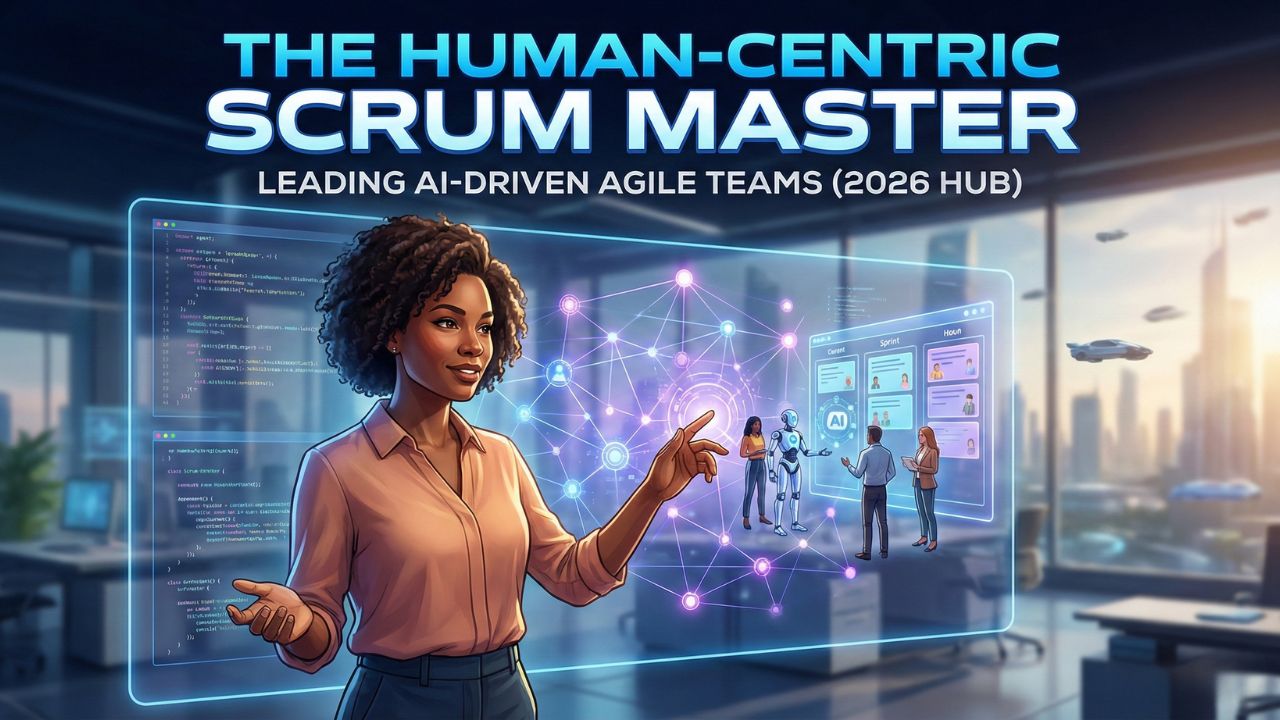
The Human-Centric Scrum Master: Leading AI-Driven Agile Teams (2026 Hub)
By 2026, the cost of generating code, test cases, and documentation has dropped to near zero. AI agents now handle the mechanics of delivery with terrifying speed. But this efficiency has created a new, critical bottleneck: The Human Element.
In an AI-saturated market, your competitive advantage is no longer just "velocity", it is trust, ethics, and cognitive sustainability. This hub serves as your central operating system for the "Cognitive Agile Enterprise." It aggregates the strategies needed to transition from a process-focused Scrum Master to a Human-Centric Leader.
Here, we explore why the human element is the premium asset and how to govern hybrid teams where humans and AI agents collaborate, collide, and create value together. We break this transformation down into three critical pillars:
- Team Dynamics: Managing conflict in hybrid Human-AI squads.
- Career Strategy: Evolving into an AI Ethicist and Orchestrator.
- Mental Health: Preventing burnout using Cognitive Load Theory.
Pillar 1: The New Conflict Resolution
Facilitating the Hybrid Team
The dynamics of the Scrum Team have fundamentally changed. You are no longer just mediating disputes between two developers; you are mediating friction between high-speed AI agents and human judgment.
When an AI agent generates code that passes all tests but violates a subtle UX principle, how do you handle the "pushback"? How do you maintain psychological safety when half your team is synthetic and never sleeps? This section explores the new soft skills required to debug "cognitive friction" and facilitate consensus in mixed-intelligence environments.
- Key Focus: Psychological safety with synthetic members, cognitive friction, and human-agent mediation.
Read the Full Guide: Facilitating the Hybrid Team: Conflict Resolution Between Humans and AI Agents
Pillar 2: The Career Pivot (2026-2027)
From Process Guide to AI Ethicist
Is the Scrum Master role dead? If your definition of the role is "updating Jira tickets" and "scheduling meetings," then yes, AI has already replaced you. But if your definition is Leadership, the role has never been more vital.
This guide acts as a survival manual for Scrum Masters fearing obsolescence. It maps out the transition from a mechanical facilitator to an AI Ethicist & Team Coach. We detail how to position yourself as the guardian of "Human-in-the-Loop" governance, ensuring that AI accelerates value without compromising ethics or security.
- Key Focus: AI ethics, future-proofing your career, and governance.
Pillar 3: The Mental Health Angle
Cognitive Load Theory in Scrum
AI doesn't get tired. Humans do. The relentless pace of AI-assisted development can easily drown a human team in a flood of code reviews, alerts, and decisions. This phenomenon is known as "Reviewer's Fatigue," and it is the primary cause of burnout in high-velocity teams.
We apply Cognitive Load Theory—a concept popularized in DevOps—to the Scrum framework. Learn how to measure the mental weight of your Sprint Backlog and how to design "sustainable pace" protocols that protect your team's most valuable asset: their minds.
- Key Focus: Preventing burnout, team topologies for AI, and managing mental fatigue.
Read the Full Guide: Cognitive Load Theory in Scrum: Preventing Burnout in High-Velocity AI Sprints
Frequently Asked Questions (FAQ)
1. Why is "Human-Centric" Agile important in the AI era?
In an AI-saturated market, code is a commodity. The "Human-Centric" approach focuses on what AI cannot do: empathy, complex conflict resolution, ethical judgment, and creative innovation. It ensures that high velocity does not come at the cost of team burnout or ethical compromises.
2. Will AI replace the Scrum Master role?
AI will replace administrative tasks (metrics, scheduling), but it cannot replace the need for coaching and governance. The role will evolve into that of an "AI Ethicist" and "Team Orchestrator," focusing on human-AI collaboration rather than just process mechanics.
3. What is "Cognitive Load" in the context of Agile?
Cognitive Load refers to the amount of mental effort required to complete a task. In AI-driven sprints, the volume of generated code can overwhelm human reviewers. Managing this load is critical to preventing burnout and maintaining quality.
4. How do you handle conflict between a human and an AI agent?
Conflict resolution in hybrid teams often involves "prompt debugging" and clarifying acceptance criteria rather than interpersonal mediation. The Scrum Master must ensure humans don't feel "judged" by the AI's output and that the AI aligns with the team's shared values.