How to Add "Secrets Rotation" to Your Scrum Definition of Done (DoD)
1. The Problem: The "Permanent" Secret Trap
In many Scrum teams, a "Done" increment includes code that is functional and tested, but it often relies on static API keys or database passwords that never change. These long-lived credentials are a primary target for attackers because their validity often stretches across many months—or even years—if left unmanaged. If a secret is leaked in January and not rotated until December, the "window of exposure" is 11 months, leaving the organization vulnerable to sustained breaches.
2. The Solution: Shifting Rotation to "Done"
By 2026, high-velocity teams are moving Secrets Rotation out of "Maintenance" and into the Definition of Done (DoD). This ensures that no feature is shipped unless its associated secrets are dynamic or automatically rotatable. This transition aligns with the broader philosophy of "Compliance as Code," ensuring security is a built-in quality metric rather than a separate, manual task.
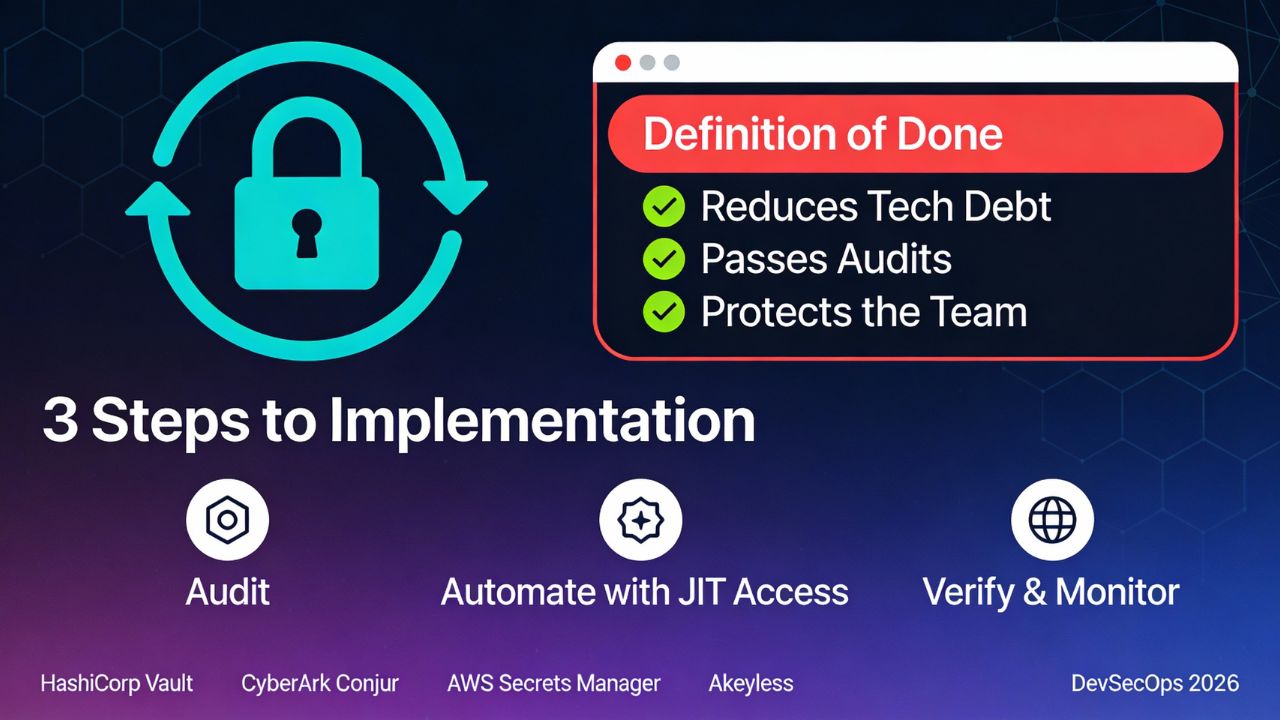
3. [How-To] 3 Steps to Implementation
Step 1: Audit & Identify (The Discovery Phase)
Task: Identify all static credentials including DB passwords, Cloud IAM keys, and third-party APIs across the application environment.
DoD Requirement: "All credentials used in this story must be registered in the centralized Secrets Manager."
Step 2: Automate with JIT Access (The Technical Phase)
Task: Replace static keys with Just-in-Time (JIT) or Dynamic Secrets using tools like Vault or Conjur.
DoD Requirement: "Credentials must have a maximum TTL (Time-to-Live) of 24 hours or be dynamically generated per session."
(You can adjust this threshold for legacy systems if needed.)
Step 3: Verify & Monitor (The Validation Phase)
Task: Use automated "Secret Scanning" in your CI/CD pipeline to ensure no hardcoded keys were accidentally committed to the repository.
DoD Requirement: "Pipeline scan confirms 0 hardcoded secrets; rotation policy is active in the production environment."
4. Automated Secrets Rotation: The 2026 Toolset
| Tool | Rotation Mechanism | Best For |
|---|---|---|
| HashiCorp Vault | Dynamic Secrets: Generates new, short-lived credentials for every request. | Cloud-native teams using Kubernetes and multi-cloud. |
| CyberArk Conjur | Centralized Policy Rotation: Rotates target passwords on a predefined schedule. | Enterprise environments requiring strict PAM compliance. |
| Akeyless | Vaultless Automation: SaaS-first rotation without managing infrastructure. | Teams wanting lower operational overhead. |
| AWS Secrets Manager | Lambda-Based Rotation: Automatically rotates keys for RDS and AWS services. | Teams heavily invested in the AWS ecosystem. |
5. Why This Matters for Scrum Masters
This isn’t just a "DevOps thing." For a Scrum Master, adding this to the DoD:
- Reduces Technical Debt: Prevents the accumulation of "hidden" security tasks that cause delays later in the release cycle.
- Passes Audits Automatically: Proves compliance at the point of delivery (SOC 2, HIPAA, PCI DSS) rather than during stressful quarterly reviews.
- Protects the Team: Ensures that a single developer’s mistake doesn’t compromise the entire product increment.
FAQ Section
Will rotation break our legacy apps?
Not if you use a Dual-Phase strategy where old and new keys both work for a short grace period during the transition.
Is this too much for a 2-week Sprint?
Only if done manually. Once automation is configured in your secrets manager and CI/CD pipeline, it takes negligible extra time per user story and significantly minimizes risk.
Sources and References
- NIST: Guide to Attribute Based Access Control (SP 800-162)
- CISA: Zero Trust Maturity Model Version 2.0
- HashiCorp: Vault Dynamic Secrets Documentation
- CyberArk Conjur: Enterprise Technical Overview and Rotation Policies
- Gartner: 2025 Magic Quadrant for Privileged Access Management
- Scrum Day India: DevSecOps 2026: The Guide to Secure Agile Delivery
To understand the foundation of these practices, visit our Identity Security Pillar Page. For a broader view of secure delivery, see our guide on DevSecOps 2026 or learn about Zero Trust for Remote Scrum Teams.