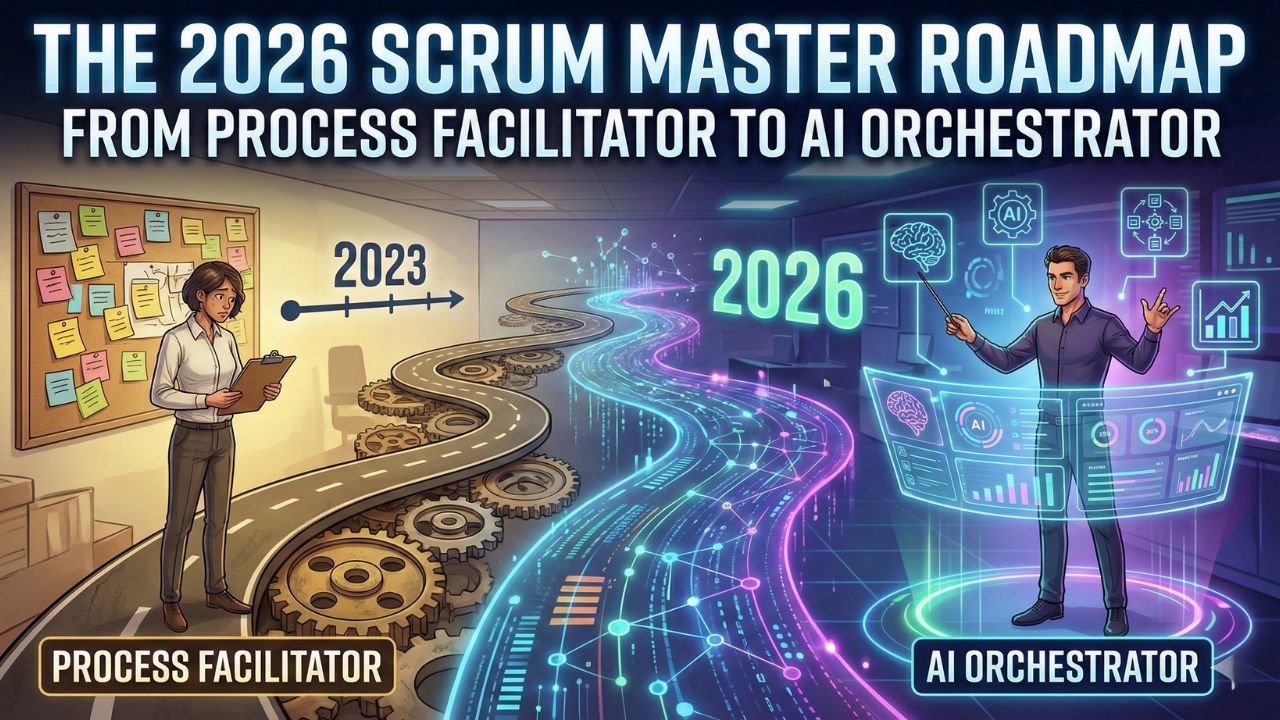
The 2026 Scrum Master Roadmap: From Process Facilitator to AI Orchestrator
The role of the Scrum Master is evolving, not disappearing. As we look toward 2026, the core values of Scrum—Courage, Focus, Commitment, Respect, and Openness—are becoming more relevant than ever, not less.
The industry is shifting. The most successful Scrum Masters in 2026 will be those who stop viewing AI as a threat and start viewing it as a force multiplier. These "AI Orchestrators" use advanced tools to handle administrative noise, liberating them to focus on the one thing AI cannot replicate: the people.
1. The "Augmented" Role: Moving Beyond Facilitation
For years, Scrum Masters have been bogged down by the mechanics of the process—chasing updates, managing Jira tickets, and compiling manual reports. The "Augmented" role changes this dynamic entirely. By integrating AI agents into the workflow, the modern Scrum Master shifts their focus from managing the process to orchestrating value.
This involves:
- Automated Refinement: Using AI to assist with backlog refinement, ensuring user stories meet the Definition of Ready before the team even sees them.
- Intelligent Metrics: Moving away from manual data entry to AI-driven analysis of Sprint metrics, providing real-time insights into team health.
- High-Value Coaching: With administrative tasks automated, you reclaim significant time to dedicate to deep-dive coaching and organizational transformation.
2. Future-Proofing Your Career
A common anxiety in the agile community is the fear of obsolescence. However, the trajectory for 2026 suggests the opposite: the demand for genuine human empathy is increasing as AI takes over data processing.
To future-proof your career, you must pivot your skill set:
- From Data Gatherer to Empathy Expert: As AI handles the quantitative data, your ability to read the room, resolve conflict, and foster psychological safety becomes your premium value proposition.
- From Process Police to Culture Architect: The "AI Orchestrator" does not just enforce rules; they build the environment where human creativity thrives alongside AI efficiency.
3. Explore the Agile AI Series
The "2026 Scrum Master Roadmap" is just the beginning. Dive deeper into specific areas of the AI-augmented role with these detailed guides:
A. Maximizing Your PSM & CSM: How AI Amplifies Your Certification
You have mastered the Scrum Guide; now learn how to apply it. This guide shows how tools like ChatGPT and Copilot can help you visualize theoretical concepts. It focuses on using AI to generate "Scenario-Based Questions" to prepare for advanced certifications like PSM II and CSP.
Read more about Maximizing Your Certification
B. Scrum Guide 2020 & AI: A Practical Addendum
The Scrum Guide is the definitive source of truth. This "Practical Addendum" explores how to uphold immutable principles while managing non-human team members. It covers using AI dashboards for Transparency, AI analysis for Inspection, and faster pivoting for Adaptation.
Read more about The Practical Addendum
C. 10 AI Prompts to Simulate Stakeholder Conflicts
Soft skills are the new hard skills. This guide acts as a training tool, treating AI as a "Practice Partner" to help you ace interviews and handle office politics. It includes prompts to simulate tough stakeholder conversations.
Read more about Simulation Prompts
Frequently Asked Questions (FAQ)
Q: Will AI tools eventually replace the Scrum Master role?
A: No. While AI can handle data and administration, it cannot replicate human connection. In fact, the demand for human empathy increases as AI handles the data, making the "human" aspect of the role more valuable than ever.
Q: What is an "AI Orchestrator" in the context of Scrum?
A: An AI Orchestrator is a Scrum Master who uses AI to handle "administrative noise"—like backlog refinement and metrics analysis—so they can focus entirely on coaching and people management.
Q: How does AI specifically help with backlog refinement?
A: In the "Augmented" role, AI tools assist by analyzing user stories for clarity and completeness, helping teams refine the backlog faster so the Scrum Master can spend more time on strategic coaching.
Q: Why is the 2026 roadmap important for my career growth today?
A: Understanding the shift toward the "Augmented" role allows you to build the right skills now—focusing on AI literacy and deep soft skills—ensuring you remain indispensable as the industry evolves.
Sources and References
- Scrum.org: Announcement of "Professional Scrum Master - AI Essentials" Training (2025/2026)
- Agile Genesis: The Future of Scrum Masters in an AI World
- PM Partners: Five Emerging Trends Shaping Project Management in 2026
- Gartner: Top Technology Trends for 2025/2026
- 17th State of Agile Report
- Software Mind: How Scrum Masters Can Benefit from AI Tools