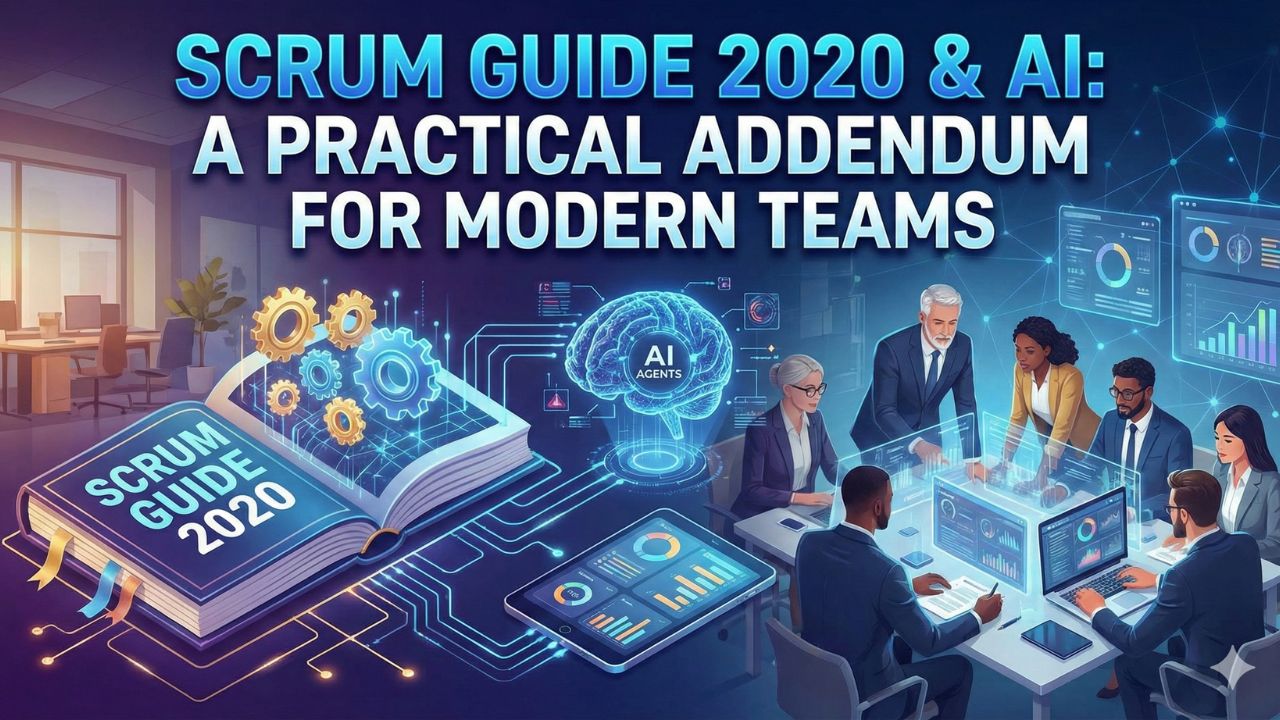
Scrum Guide 2020 & AI: A Practical Addendum for Modern Teams
The Scrum Guide 2020 is the definitive source of truth for the framework. It is immutable. However, it was written before generative AI became a team member.
This "Practical Addendum" does not change the rules of Scrum; it explores how to uphold its immutable principles—Transparency, Inspection, and Adaptation—while managing non-human team members (AI Agents). It answers the critical question: How do we maintain empirical process control when half the work is done by algorithms?
← Back to the 2026 Scrum Master Roadmap
1. Transparency: The "Glass Box" Approach
The Scrum Guide states that "significant aspects of the process must be visible to those responsible for the outcome." A common fear is that AI operates in a "black box," obscuring how value is created. To uphold Transparency in the AI era, Scrum Masters must shift from manual reporting to "AI Dashboards" that make work more visible, not less.
The Artifact:
Use automated dashboards to visualize the work of AI Agents alongside human developers in the Sprint Backlog.
The Practice:
Ensure that AI-generated code or content is explicitly tagged. The team must know who (human or machine) created the increment to ensure accountability.
2. Inspection: Defeating Recency Bias
Scrum relies on frequent inspection to detect undesirable variances. However, human inspection is often plagued by "Recency Bias"—remembering only the last few days of a Sprint during the Retrospective. AI amplifies Inspection by acting as an impartial observer.
The Workflow:
Instead of relying on memory, use AI tools to analyze the entire history of the Sprint—commit logs, ticket cycle times, and communication patterns.
The Result:
The AI presents a data-driven summary of bottlenecks (e.g., "Tickets spent 40% of the sprint in 'Pending Review'"), allowing the team to inspect reality rather than their perception of reality.
3. Adaptation: The High-Velocity Pivot
Adaptation becomes pointless if it happens too late. The Scrum Guide requires teams to adjust their course "as soon as possible" when deviation occurs. AI accelerates Adaptation by processing empirical data faster than any human can.
Predictive Pivoting:
"Agentic AI" systems can alert the Product Owner mid-Sprint if the current pace suggests the Sprint Goal is at risk, suggesting scope adjustments before the Sprint Review.
Market Feedback:
AI tools can analyze user feedback and usage metrics in real-time, allowing the Product Owner to adapt the Product Backlog instantly based on market sentiment rather than waiting for monthly reports.
Frequently Asked Questions (FAQ)
Q: Does using AI violate the Scrum Value of 'Openness'?
A: Not if you are transparent about its usage. Hiding the use of AI violates Openness. Using AI openly to handle mundane tasks so the team can focus on complex problems actually supports the Scrum Values.
Q: How do we "inspect" work done by an AI?
A: The Definition of Done (DoD) applies to AI just as it does to humans. You must inspect the outcome, not just the output. If an AI writes code, a human must review it against the DoD to ensure quality and security.
Q: Can an AI Agent attend the Daily Scrum?
A: While an AI shouldn't "attend" in the human sense, its data should be present. An AI agent can summarize its progress on automated tasks (e.g., "Regression testing 80% complete") so the team can plan the next 24 hours effectively.
Q: Does AI remove the need for the Sprint Retrospective?
A: No. AI provides the data (the "what" happened), but only the human team can determine the improvement (the "how" to fix it). AI supports the event; it does not replace the conversation.