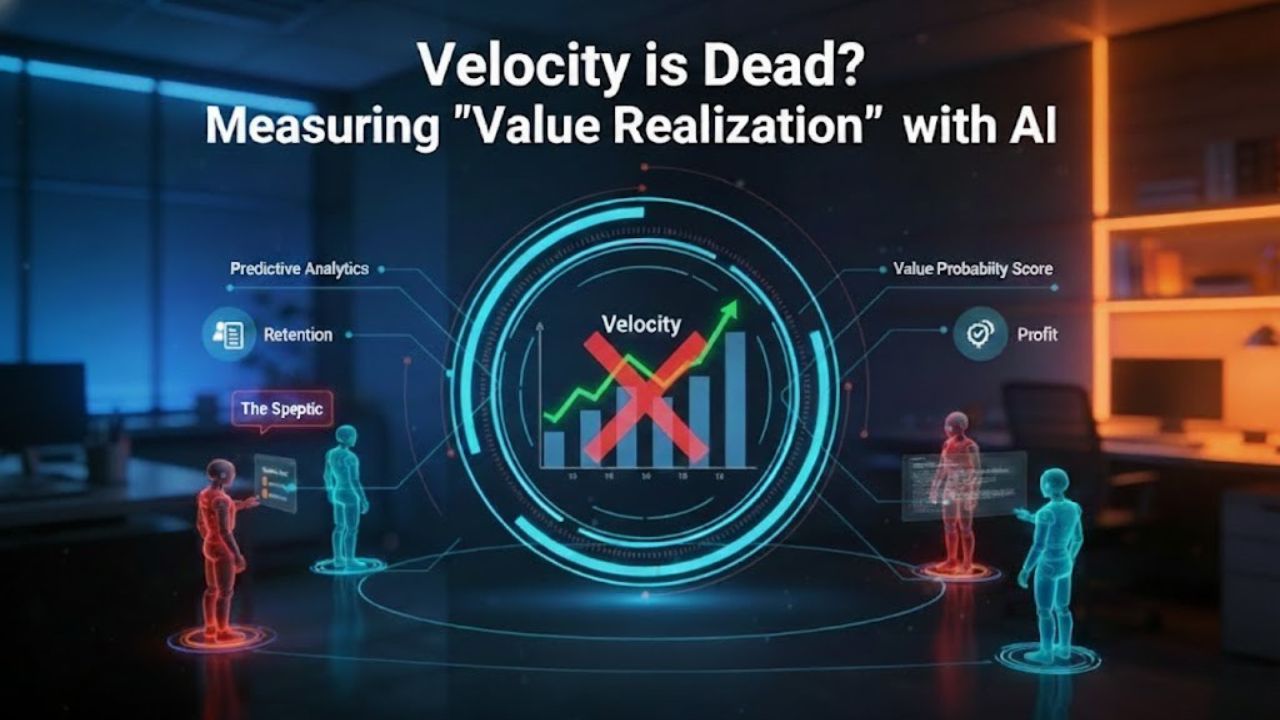
Velocity is Dead? Measuring "Value Realization" with AI
For decades, Agile teams have obsessed over Velocity—a metric of output that tracks how many story points a team completes in a sprint. However, in 2026, the Agentic Product Owner recognizes that velocity is increasingly irrelevant and easily manipulated. If an AI agent can write the code, does story points per sprint still indicate success? The focus has shifted from measuring volume to measuring Value Realization.
The Shift: Output vs. Outcome
Traditional velocity measures how much we built, but it fails to answer if what we built actually mattered. In the agentic era, we use predictive analytics to measure real-time outcomes rather than static output.
- From Points to Probability: Agents analyze historical data and market trends to assign a Value Probability Score to every item in the backlog.
- Predictive Analytics: Instead of looking backward at past sprints, we use AI to ask: What is the probability this specific feature increases user retention by 5%?
- Synchronization Signals: We track the gap between identifying an opportunity and capturing its value, ensuring organizational speed matches AI speed.
Real-Time Value Tracking
Unlike velocity, which is only calculated at the end of a sprint, value realization is tracked continuously.
| Metric | Traditional Velocity (2020) | Value Realization (2026) |
|---|---|---|
| Primary Focus | Volume of work (Story Points) | Impact of work (Business ROI) |
| Nature | Descriptive (What happened) | Predictive (What will happen) |
| Timing | Post-Sprint Review | Real-time Value Probability updates |
| Incentive | Completing more tickets | Moving the needle on OKRs |
FAQ: Metrics & Value in 2026
Q: If we stop measuring velocity, how do we plan team capacity?
A: We use Predictive Project Health scores. AI agents analyze the complexity of the Prompt Chains and the team's historical flow efficiency to forecast completion dates with higher accuracy than manual estimation.
Q: What is a Value Probability Score?
A: It is a metric generated by AI that estimates the likelihood of a backlog item achieving a specific business outcome, such as revenue growth or cost reduction, based on past feature performance.
Q: Does AI-powered measurement replace human judgment?
A: No. The AI provides the data-driven Signal, but the Product Owner remains the Orchestrator who makes the final strategic decision based on that signal.
Sources and References
- Agentic Product Ownership Hub (2026). Velocity is Dead? Measuring 'Value Realization' with AI.
- Scrum.org (2025). Beyond Velocity Metrics: How to Measure AI-Agile Synchronization.
- IBM (2025). What is Value Realization?
- Scrum Day India (2025). The Agentic Product Owner: Field Guide to AI-Driven Value 2026.