Iterative Prototyping for Physical Products: Fail Fast Without Going Broke
Quick Summary: Key Takeaways
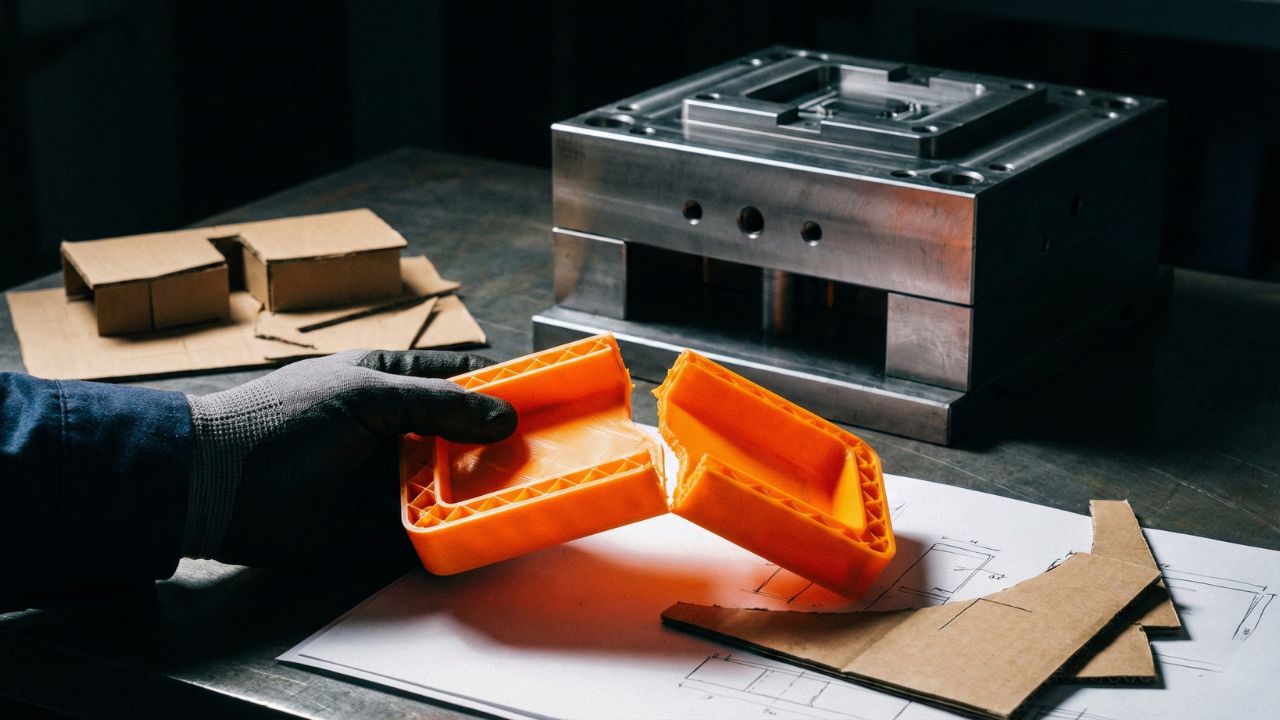
- Fail Cheaply: It is significantly cheaper to fail with cardboard and plastic than with steel molds and final circuitry.
- Fidelity Ladder: Stop trying to build the final product immediately. Move from low-fidelity low-fidelity prototyping to functional models to test specific hypotheses.
- Sprint Integration: Use 3D printing to fit hardware iterations into 2-week Agile sprints, creating a physical "Definition of Done".
- Risk Reduction: Iteration validates engineering decisions before they become expensive manufacturing mistakes.
Stop Building Expensive Paperweights
In software, if you deploy code that breaks, you roll it back. It costs virtually nothing.
In hardware, "undoing" a mistake often means scrapping a $50,000 injection mold or recalling thousands of units. Physics is hard because atoms are expensive.
The traditional "Waterfall" approach tries to mitigate this by planning for months. Engineers design, simulate, build once, and pray it works. But by the time the product ships, customer needs have often changed, resulting in a perfectly engineered product that nobody wants.
To survive, you must master iterative prototyping for physical products. This approach allows you to test hypotheses rapidly and cheaply. Instead of a "Big Bang" release, you move through rapid cycles of design and testing.
Note: This deep dive is part of our extensive guide on Agile for Hardware Development: The Ultimate Guide to Iterating on Atoms.
The "Fidelity Ladder": How to Iterate Without Bankruptcy
Many engineering teams resist Agile because they believe they cannot produce a "shippable" hardware increment in two weeks. They are right—you can't build a car in two weeks. But you can build a working door handle.
Successful agile manufacturing relies on climbing the "Fidelity Ladder". You must match the prototype material to the specific question you are trying to answer.
1. Low-Fidelity Prototyping (The "Looks-Like" Model)
Before you open CAD, start with cardboard, foam, or clay.
- Goal: Test form factor and ergonomics.
- Cost: <$50.
- Speed: Hours.
2. 3D Printing in Agile (The "Works-Like" Model)
Once the shape is defined, use rapid additive manufacturing.
- Goal: Test mechanism, fit, and assembly.
- Cost: <$200.
- Speed: Days. This is where rapid prototyping agile shines.
You can print overnight, test in the morning, and adjust the CAD file by the afternoon.
3. Functional/Engineering Samples
Only after the cheap iterations pass do you move to CNC machining or soft tooling.
- Goal: Test thermal properties, stress, and final material behavior.
- Cost: High.
- Speed: Weeks.
Integrating Prototyping into Scrum Sprints
How do you fit hardware into a Sprint?
You must treat the prototype as the "Working Software" equivalent. Your sprint goal shouldn't be "Final Product," but rather "Validated Hypothesis".
For example, a team designing a robotic arm might spend a sprint solely on the gripping mechanism. The "Done" increment is a 3D-printed claw that can pick up a ball.
We see this velocity clearly when analyzing prototyping in the automotive industry, where companies like Tesla iterate on physical car parts weekly rather than waiting for annual model updates.

Frequently Asked Questions (FAQ)
How does rapid prototyping fit into Scrum sprints?
Rapid prototyping enables the "Inspect and Adapt" loop in hardware. By using fast fabrication methods like 3D printing in agile, teams can produce a tangible item to review at the end of a sprint, ensuring the design is moving in the right direction before expensive tooling begins.
What is the difference between an MVP and a prototype in hardware?
A prototype answers a specific engineering question (e.g., "Will this gear strip under load?"). A Hardware MVP (Minimum Viable Product) is the smallest version of the product that can be sold or given to a customer to validate the market need.
How to budget for iterative hardware testing?
Budget for "waste." Traditional budgets assume you build it once. Agile budgets must allocate funds for multiple failures. However, spending $5,000 on five failed 3D prints is infinitely cheaper than spending $100,000 on one failed steel mold.
Can you 3D print a "working software" equivalent?
Yes. While you cannot ship a 3D print to a mass-market consumer, it serves as the "Potentially Shippable Increment" for internal stakeholders, allowing for user testing and physical validation.
How to reduce the cost of hardware iteration cycles?
Focus on low-fidelity prototyping early in the process. Do not move to metal or high-grade plastics until the design logic has been proven in cheaper materials. Use modular designs so you only have to reprint the part you changed, not the whole assembly.
Conclusion: Respect Physics, But Don't Fear It
The laws of physics are strict, but they shouldn't be an excuse for slow management. By adopting iterative prototyping for physical products, you shift the risk from the end of the project (deployment) to the beginning (design).
You will break things. You will print parts that don't fit. But you will do it when the cost is measured in pennies, not millions.