Scrum in Automotive Manufacturing: Lessons from the EV Revolution
Quick Summary: Key Takeaways
- Death of the "Model Year": Leading EV manufacturers update physical hardware weekly, not annually.
- Extreme Manufacturing: Techniques like "WikiSpeed" prove you can iterate on chassis and bodywork within a 1-week sprint.
- Modular Architecture: To move fast, vehicles must be built like LEGOs, allowing isolated upgrades without redesigning the whole car.
- Compliance as Code: Regulatory safety checks are automated and embedded into the Definition of Done.
The End of "Design, Build, Pray"
For decades, the automotive industry operated on a rigid heartbeat: the Model Year. Engineers would lock designs years in advance, spend billions on tooling, and release a car that was effectively obsolete the moment it hit the dealer lot.
That era is over.
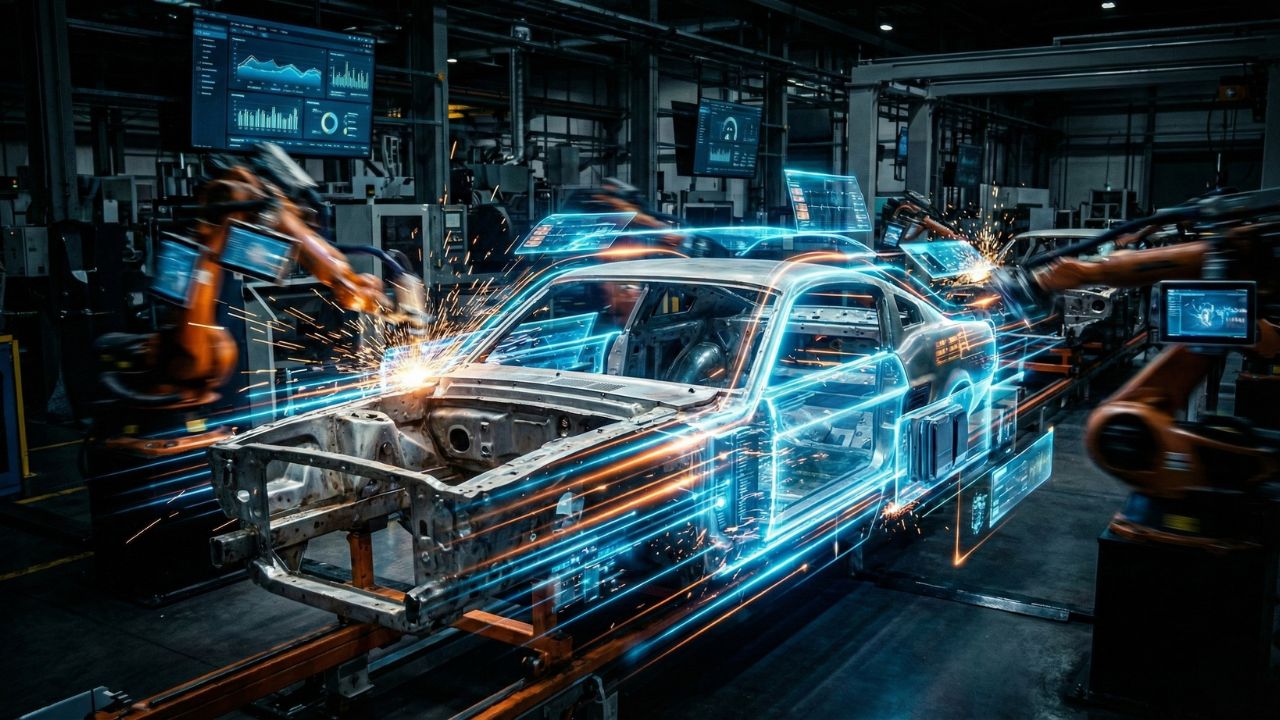
The rise of scrum in automotive manufacturing has introduced a terrifying reality for legacy automakers: competitors who update their hardware as fast as their software. Instead of waiting for a mid-cycle refresh to fix a latch or improve battery efficiency, companies like Tesla change the production line the moment an improvement is verified.
Note: This deep dive is part of our extensive guide on Agile for Hardware Development: The Ultimate Guide to Iterating on Atoms.
The Tesla Effect: Iteration on the Assembly Line
How does a company run Sprints when dealing with thousands of tons of steel?
The secret lies in decoupling. Traditional cars are highly integrated monocoques; if you change the dashboard, you might have to redesign the firewall. Agile manufacturers prioritize modular architecture. By treating the vehicle as a collection of independent modules (powertrain, infotainment, chassis), teams can iterate on one system without breaking the others.
- Continuous Improvement: If a manufacturing engineer finds a way to stamp a panel cheaper, they don't file a request for next year. They implement it next week.
- Feedback Loops: Data from the fleet informs engineering immediately. If sensors detect a vibration in the rear motor mount, the design team gets a ticket in their backlog instantly.
Extreme Manufacturing (XM): The Joe Justice Approach
The concept of "Extreme Manufacturing" (XM) was pioneered by Joe Justice and his Team WikiSpeed. They asked a radical question: Can we build a road-legal car in a one-week sprint?
Using Scrum, they managed to iterate on a 100MPG car with the same velocity as a software team.
The Core Principles of XM:
- Object-Oriented Hardware: Parts connect via standard interfaces. You can swap the engine module from gas to electric in minutes because the bolt pattern (the "interface") stays the same.
- Test-Driven Manufacturing: You don't build, then test. You define the test (e.g., "must withstand 5G impact"), then build to pass it.
Surviving the Supply Chain Crisis
Speed is useless if you don't have parts. One of the biggest blockers to agility in automotive is the global supply chain. If you rely on rigid, Just-in-Time (JIT) delivery for every single bolt, a single disruption halts the line.
Agile manufacturers mitigate this by keeping "Plan B" options in the backlog and designing flexibility into their electronics. For a deeper look at handling these disruptions, you must master managing supply chain issues in automotive, which often involves dynamic sourcing strategies that traditional procurement teams find uncomfortable.

Frequently Asked Questions (FAQ)
How does Tesla use Agile in manufacturing?
Tesla applies Agile by removing the "freeze" date on designs. They introduce running changes to the production line continuously. If a part is improved, it is cut into production immediately, meaning two Model Ys built a month apart may have different internal hardware.
Can you run Sprints on an assembly line?
Yes, but the "Increment" looks different. In software, the increment is code. On an assembly line, the Sprint goal might be "Reduce door installation time by 10%" or "Switch to new fastener type." The factory floor itself is the product being iterated on.
What is "Joe Justice" Extreme Manufacturing?
Joe Justice created the "Extreme Manufacturing" method with Team WikiSpeed. It applies XP (Extreme Programming) principles to hardware: pairing on fabrication, test-driven development for physical parts, and modular design to allow rapid swapping of components.
How to manage regulatory compliance in Agile automotive?
Compliance cannot be an "afterthought." In Agile automotive, compliance tests (crash simulation, emissions) are part of the Definition of Done. You do not mark a module as complete until it passes the digital twin simulation for regulatory standards.
Examples of Agile transformation in car companies?
Beyond Tesla, Toyota has long used "Lean" (the grandfather of Agile). Bosch and Saab Aeronautics (building the Gripen fighter jet) also use Scrum to manage complex hardware integration, proving this works for safety-critical systems.
Conclusion: Evolve or Rust
The transition to scrum in automotive manufacturing is not just about moving faster; it is about risk management. In a volatility-filled world, the company that can change its product the fastest wins.
The "Model Year" is a relic of an era when re-tooling cost millions and took months. Today, with 3D printing, modular design, and smart factories, the cost of change is dropping. The only thing keeping the old way alive is mindset. Don't let your process become a fossil.