Measuring Blended Human + AI Throughput, Honestly
Key Takeaways
- Unified measurement: Human and AI throughput cannot be separated; they must share a blended model to expose handoff friction accurately.
- The new bottleneck: AI shifts the primary delivery constraint from code drafting directly to human code review and integration.
- WIP limits must evolve: Work in Progress (WIP) limits must account for high-speed AI output to prevent overloading human reviewers.
- Lead time is truth: Blended throughput relies heavily on end-to-end lead time to prove whether AI speed actually equals business value.
- Avoid local optimization: Maximizing AI coding speed without expanding verification capacity is a local optimization that damages the whole system.
Measuring human and AI team throughput needs a blended model, not two dashboards. One hidden bottleneck easily cancels your AI gains—find it before the next QBR.
When you introduce coding agents, treating the machine output and human effort as separate ecosystems is a fatal error. If you have studied our central agentic-era agile metrics framework, you understand that delivery relies on the entire system.
Raw AI speed must be contextualized by human capacity. This deep dive shows you how to unify your reporting and spot the specific constraints choking your deployment pipeline.
What is Blended Throughput in Agile?
Blended throughput is the measurement of work moving through a system where tasks are continuously handed back and forth between human engineers and AI agents.
In a traditional agile team, throughput measures human effort entirely. In the agentic era, work is collaborative. An AI agent might draft the scaffolding, a human might tweak the architecture, the AI generates the test suite, and a human performs the final code review.
Because the work is entangled, tracking the AI's "productivity" in isolation is completely meaningless. You must measure the combined team's ability to turn an idea into shippable value.
Why Separate Dashboards Hide the Real Bottleneck
Many enterprises make the mistake of building an "AI Productivity Dashboard" separately from their standard Jira flow board. This guarantees failure.
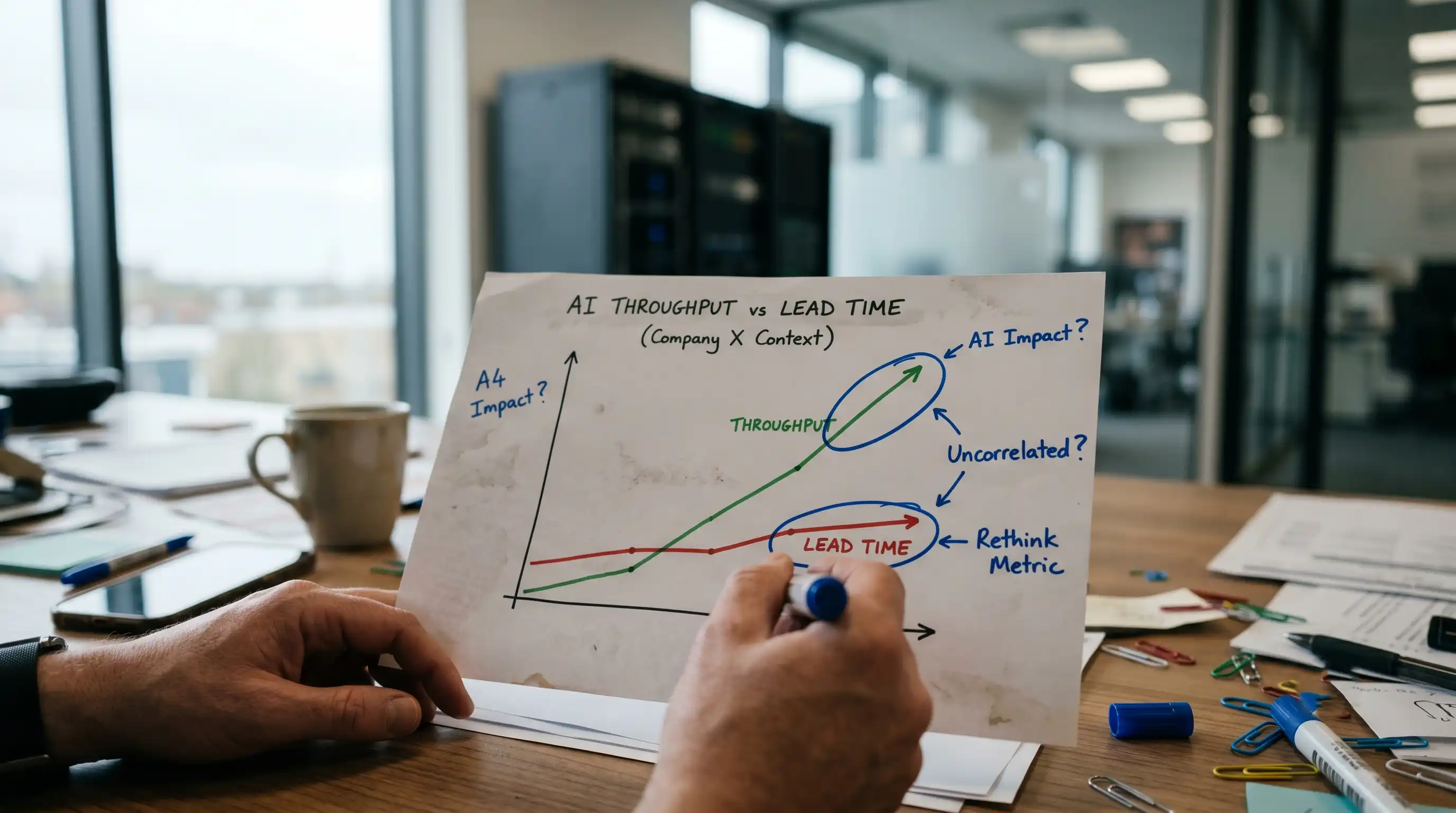
When you separate the dashboards, the AI board looks incredible. Generation speed is off the charts. But the actual human release cadence remains stagnant.
Why? Because separating the views hides the handoff. As you learn to correctly measure AI coding agent productivity, you must realize that value is only created when the entire cross-functional process completes.
The Code Review Constraint
If you view the blended system honestly, you will immediately see that AI shifts the constraint directly to code review.
Agents generate pull requests faster than any human can read them. If your throughput model doesn't blend these two forces, you will miss the massive pile-up in your verification queues until your developers burn out.
Setting WIP Limits for AI Agents
Work in Progress (WIP) limits are designed to prevent systemic bottlenecks. In a blended team, you must enforce WIP limits on your AI agents.
If your human team can only review and securely integrate five features per week, your AI agents should not be drafting thirty features per week. Overproduction is waste.
Letting agents generate unverified code that sits idle in a repo creates massive technical debt. You must set strict WIP limits on the "Drafting" column, matching the speed of your human "Review" column.
How to Visualize Blended Flow in Jira
To visualize this effectively, you need a single, continuous flow board. AI and human work should not have separate swimlanes if they represent the same delivery pipeline.
Use tagging or custom issue types to identify who is primarily driving a specific task. However, the workflow columns—Drafting, Review, Testing, Deployment—must remain unified.
For the precise mechanics of setting this up, our legacy documentation on building a flow metrics dashboard remains the technical gold standard.
Avoiding Local Optimization with Lead Time
Optimizing AI drafting speed while ignoring human verification is the definition of local optimization. It makes one part of the pipeline incredibly fast while doing nothing for the end customer.
To avoid this, your primary metric for blended throughput must be Lead Time. If your agents generate code in five minutes, but the PR takes five days to get reviewed and merged, your AI investment is not generating a return.
Lead time forces the PMO to acknowledge that the team is only as fast as its human verification phase.

Frequently Asked Questions (FAQ)
How do you measure combined human and AI throughput?
Measure combined throughput by tracking the total number of value-delivering items successfully moving from concept to production. Do not measure AI output and human output separately; instead, measure the end-to-end flow of the blended team using unified Lead Time and Cycle Time metrics.
What is blended throughput in agile?
Blended throughput is a delivery metric that evaluates a system where AI coding agents and human engineers continuously collaborate. It treats the "silicon" and "carbon" workforces as a single entity, focusing on how effectively they pass work between each other to reach "Done."
Should AI and human work share one metric?
Yes. Measuring them separately creates a false sense of speed, as AI output volume will look massive while actual deployments remain flat. Sharing one delivery metric forces the organization to acknowledge that unreviewed AI code holds zero business value.
How does WIP change with AI agents?
Work in Progress (WIP) typically spikes dramatically when AI agents are introduced because drafting code becomes near-instantaneous. Teams must aggressively enforce new WIP limits on the initial coding columns to prevent overwhelming the downstream human reviewers.
Where do AI agents create new bottlenecks?
AI agents almost universally shift the bottleneck from code generation (drafting) to code verification. The massive influx of generated code creates instant bottlenecks in Pull Request reviews, security auditing, QA testing, and architectural alignment checks.
How do you visualize blended flow in Jira?
Visualize it using a single, unified Kanban board. Do not use separate swimlanes for AI. Instead, use custom tags to denote AI-assisted work, allowing the team to see exactly where the high-speed AI tasks are piling up in the human review columns.
Does AI shift the constraint to code review?
Yes. Because coding agents can generate complex boilerplates in seconds, the constraint—the slowest point in your delivery pipeline—immediately shifts to the human engineers who must read, understand, secure, and approve that generated code.
How do you set WIP limits for AI agents?
Set WIP limits based on your team's verification capacity, not the AI's generation capacity. If your human engineers can only safely review 10 PRs per sprint, your AI agents should be artificially capped at drafting a maximum of 10 PRs.
What is the lead time impact of AI agents?
Initially, AI agents often worsen Lead Time because they flood the system with work, causing PRs to sit idle in queues. To improve Lead Time, PMOs must invest in expanding human review capacity or implementing AI-assisted automated testing.
How do you avoid local optimization with AI?
Avoid local optimization by tying AI success strictly to end-to-end Lead Time and Escaped Defect Rates. Acknowledging that increasing coding speed without increasing verification speed is a localized improvement that damages overall system throughput.