Professional Scrum Facilitation Skills (PSFS) Training in India
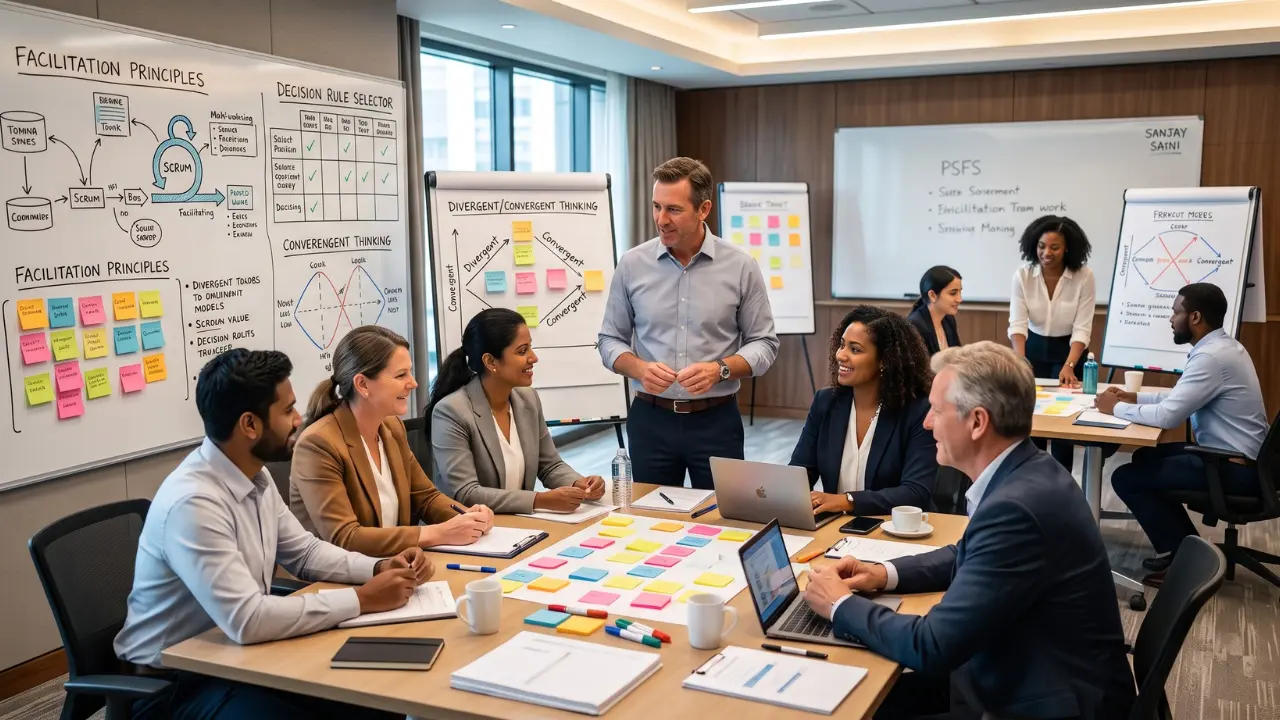
Professional Scrum Facilitation Skills (PSFS) is a one-day, highly interactive Scrum.org class for Scrum Masters and Scrum Team members who want their events to produce real decisions instead of long conversations. You learn facilitation by doing it, in a room where every exercise is itself a technique you can take back to your team.
Most Scrum events do not fail because the team misunderstands the framework. They fail because nobody is holding the container. The Sprint Planning drifts, the loudest voice wins the refinement, the Retrospective turns defensive, and everyone leaves assuming a different decision was made. This class gives you the principles, the techniques and the judgment to change that.
Is this class right for you?
Check every box where your answer is YES:
- Do your Scrum events run long and end without a clear decision?
- Does one confident voice regularly decide things for the whole team?
- Do your Retrospectives feel like a routine the team has stopped learning from?
- Do you freeze when a stakeholder attacks the team in a Sprint Review?
- Do you want a repertoire of techniques rather than one default format you reuse forever?
- Do you want a lifetime Scrum.org certification that proves facilitation capability?
If you checked even one box, this one-day class is built for you.
Quick Class Facts
Upcoming Dates: Contact us for the current schedule
Time: 10:30 AM – 5:00 PM IST (Asia/Kolkata)
Delivery: Live virtual class via Zoom with a digital collaboration board
Trainer: Sanjay Saini (Professional Scrum Trainer, Scrum.org)
Certification: PSFS assessment password included
Language: English
Why Facilitation Is Now the Constraint
Teams have never had faster access to options. Ideas, drafts, designs and analyses arrive in minutes. What has not sped up is the human work of getting a group of people to look at those options together, disagree honestly, and commit to one path.
That is why facilitation has quietly become the bottleneck on most Scrum Teams. The constraint is no longer generating possibilities; it is converging on a decision that everyone will actually act on. A team that can move through disagreement to a clear, transparent decision will outperform a faster team that keeps relitigating the same choices.
Facilitation is the skill that closes that gap. It is not chairing a meeting or keeping time. It is designing and holding a conversation so that the group does its best thinking, surfaces the awkward truth early, and knows exactly when the decision has been made.
What You Will Learn
By the end of the class you will be able to:
- Define facilitation properly — what it is, what it is not, and what mindset it asks of you.
- Apply the facilitation principles — participatory, purposeful, healthy, transparent and process-driven — to each Scrum event and to the interactions between them.
- Read the signals that tell you a conversation needs a facilitator to step in, and decide when stepping back serves the team better.
- Move a group from diverging to converging, including how to recognise and survive the messy middle where most groups give up and default to a familiar answer.
- Make the decision rule explicit so the team knows how a decision will be made before it starts arguing, and knows when it has been made.
- Handle the hard situations — a Sprint Planning going off the rails, a Retrospective turning personal, a Developer who has stopped attending the Daily Scrum, a stakeholder publicly dismissing the team's work.
- Build a personal improvement plan using a facilitation canvas, so you leave with a first move rather than a stack of notes.
Course Agenda
- Introduction: Creating a safe and transparent space, and establishing how this group will work together.
- Facilitation Principles and Scrum: The five principles, the purpose of each Scrum event, and how the Scrum Values shape the way you facilitate.
- Applying Facilitation Skills and Techniques: The twelve facilitator skills, group dynamics, divergent and convergent thinking, and decision rules.
- Improving Facilitation Skills: Assessing where you are today and building your facilitation improvement action plan.
- Closing: Reflection, feedback and next steps on your Scrum Master learning journey.
Throughout the day you get optional opportunities to facilitate the class yourself. Volunteering is always your choice, and passing is always allowed.
Techniques You Will Practise
You do not just hear about these techniques. You experience each one as a participant and then discuss when it works and when it backfires.
| Technique | What it is good for |
|---|---|
| 1-2-4-All | Getting every voice into the room fast, and letting people own the idea they contributed. |
| Individual writing | Protecting quiet thinking before the group conversation shapes everyone's answer. |
| Worst possible idea | Lowering the stakes so a self-conscious group starts talking honestly. |
| Affinity mapping | Turning a wall of scattered input into visible themes the group can act on. |
| Working agreements | Making shared expectations explicit instead of leaving them assumed. |
| Dot voting and Roman voting | Reading the level of agreement in a group quickly, without a long debate. |
| Troika Consulting | Getting real peer advice on your own hardest problem in a short timebox. |
| White Elephant | Ranking options as a group when everyone has an opinion and nobody agrees. |
| Gallery Walk / Shift & Share | Creating transparency across several teams without a marathon presentation. |
| Perfection Game | Collecting feedback that is specific and improvement-oriented rather than a score. |
Who Should Attend
- Scrum Masters who want facilitation to be a strength rather than the part they improvise.
- Any Scrum Team member — Developer or Product Owner — who runs or shapes team conversations.
- Agile Coaches, Scrum Coaches and consultants working across multiple teams.
- Managers and leaders who run working sessions and want fewer, better meetings.
- Anyone preparing for the Scrum.org PSFS certification assessment.
The class assumes you already know Scrum. If you are completely new to it, take Professional Scrum Master first and come back to this one.
Training Fees & Registration
| Participant Type | Fee Details | Benefit |
|---|---|---|
| Indian Participants | INR 13,990 + 18% GST (Total: 16,508 INR) + Payment Gateway | 1000 INR discount for ex-students. Direct bank transfer saves the payment gateway charge. |
| International Participants | $295 USD + Payment Gateway | $50 discount for ex-students. |
Bank Account Details for Direct Transfer (HDFC Bank)
Account Name: AgileWoW Consulting Services Pvt Ltd
A/c No: 50200052216092
IFSC Code: HDFC0004809
Branch: Sector 46, Gurugram
What’s Included?
- A full day of live instruction with a licensed Professional Scrum Trainer.
- One free attempt at the Scrum.org PSFS certification assessment.
- A second free attempt if you take the assessment within 14 days of class and score below 85%.
- PDUs/SEUs for professional credit with PMI and Scrum Alliance.
- The class reference guide and a copy of the collaboration board used in class.
- Lifetime certification on passing — no renewal fee, no annual maintenance.
Frequently Asked Questions
No. There is no formal prerequisite. You do need working knowledge of Scrum, because the class applies facilitation to real Scrum events rather than teaching the framework itself. If you have never worked on a Scrum Team, start with Professional Scrum Master.
Both. Professional Scrum Facilitation Skills is a Scrum.org class, and attending it includes a password for the PSFS certification assessment. You take the assessment online in your own time after class.
You need 85% to pass. If you attempt the assessment within 14 days of the class and score below 85%, Scrum.org grants a second attempt at no extra cost.
PSM covers the Scrum framework and the Scrum Master accountability. PSFS is a skills class focused on one thing: facilitating the conversations that happen inside Scrum. It goes deep on group dynamics, decision making and difficult situations rather than broad on Scrum theory.
No. Product Owners, Developers, Agile Coaches, consultants and managers who run working sessions all get value from it. Facilitation is a shared team skill, not a Scrum Master monopoly.
Public classes run live and virtual over Zoom with a digital collaboration board, in a single full day from 10:30 AM to 5:00 PM IST. In-person delivery is available for private in-house cohorts.
No. Scrum.org certifications are held for life. There is no renewal fee and no annual maintenance requirement.
Yes. We run private cohorts tailored to your context, including your own team scenarios. Email support@agilewow.com or message +91-8368865197 for dates and group pricing.
Also curious about AI in your Scrum practice?
Facilitation decides how a team converges. AI decides how fast the options arrive. Our AI Essentials for Scrum Masters workshop covers prompting, ethics and using AI as a thinking partner for your team.
Other Classes You May Want
Continue building your Scrum Master and Product Owner capability:
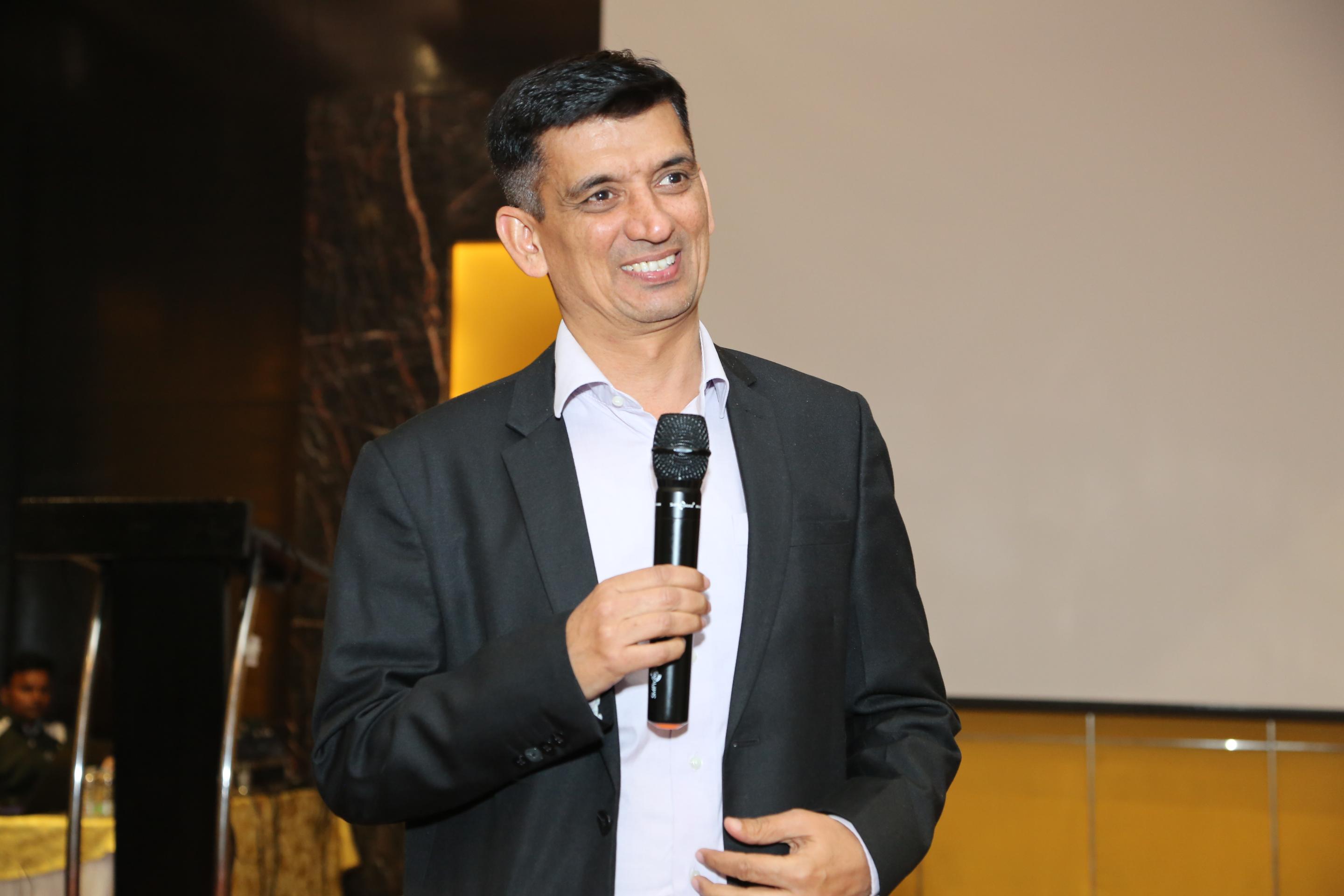
Meet Your Trainer: Sanjay Saini
Professional Scrum Trainer, Scrum.org
Sanjay Saini is a licensed Professional Scrum Trainer who has spent years in the room with Scrum Teams across India and global delivery centres. He teaches facilitation the way he practises it: through real team situations, not slideware.
Connect on LinkedInContact Us
For group bookings, in-house delivery or any question about the class:
WhatsApp: +91-8368865197
Email: support@agilewow.com
Ready to Facilitate Better Conversations?
Classes are kept small so everyone gets to facilitate. Secure your seat.
Professional Scrum™, Professional Scrum Facilitation Skills™, PSFS and the Scrum.org logo are trademarks of Scrum.org. This class is delivered by Sanjay Saini, a licensed Professional Scrum Trainer, under licence from Scrum.org.