How to Pass PSM I on Your First Attempt
Key Takeaways
- Internalize the Guide: Success requires a deep, phrase-by-phrase internalization of the official Scrum Guide, not simple surface memorization.
- Pacing Competency: You must train yourself to answer situational questions in under 45 seconds to comfortably survive the strict 60-minute clock.
- Open Assessment Targets: Do not purchase your exam voucher until you score a consistent 100% on official practice assessments multiple times.
- Eliminate Trap Words: Train your eye to flag absolute language such as "must," "always," or "mandated" which often point to incorrect answers.
Cracking the Professional Scrum Master assessment on your first try requires a structured study plan, an intentional mock-exam strategy, and an acute awareness of the traps that routinely fail candidates.
Because this test demands absolute clarity on agile delivery, walking in unprepared is a highly expensive gamble.
Before you lock in your preparation schedule, make sure you anchor your approach in our core Scrum Master Certification Decision Hub to understand how this milestone fits into your long-term upskilling path.
Let’s dive straight into the exact blueprint required to guarantee a passing score.
The Core Strategy: Deep-Diving the Scrum Guide
The absolute foundation of your preparation is the official Scrum Guide.
This lightweight document contains the literal rules of the game, and every single question on the assessment directly tests its boundaries.
Deconstructing Roles and Accountabilities
You must completely scrub away any real-world corporate biases you have witnessed in compromised agile environments.
The exam does not care how your current company runs sprints.
Focus deeply on the clear operational boundaries separating the Scrum Master, the Product Owner, and the Developers.
Memorize who is explicitly accountable for the Sprint Backlog, who manages stakeholder commitments, and who owns quality definitions.
If you are still deciding whether this intense theoretical testing matches your professional style, review our direct breakdown of PSM I vs CSM to evaluate your options.
Mock Exam Strategy: Simulating the Test Environment
To beat a high-stakes exam, you must practice under identical structural constraints.
Sitting down to a fast-paced digital test without prior time-box conditioning is a major recipe for failure.
Leveraging the Scrum Open Assessments
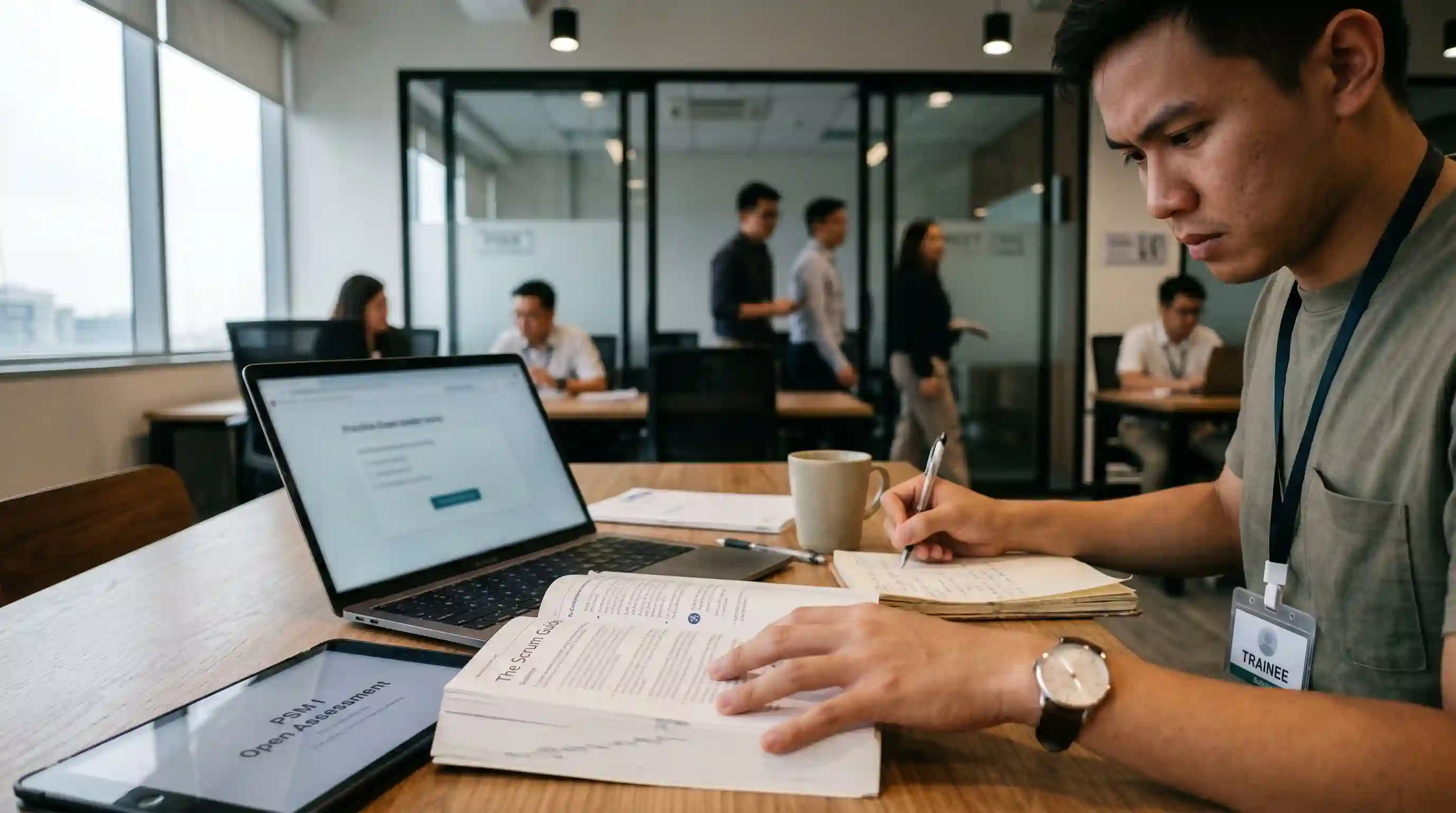
Scrum.org provides excellent, free practice tools known as the Scrum Open assessments.
While these sample pools are shorter than the real exam, they use identical phrasing and interface mechanics.
Your goal is to complete the Open assessment multiple times until you can reach a flawless 100% score within less than 5 minutes.
This level of repetition builds the rapid pattern recognition needed to handle the real exam's 80-question gauntlet.
Common Pitfalls and Trap Words to Avoid
The assessment layout uses highly nuanced scenario testing to see if you understand the spirit of servant leadership.
Always watch out for absolute words like "assigns," "directs," or "manages" when describing a Scrum Master’s relationship with developers.
True Scrum relies heavily on self-management, meaning any answer choice that hints at top-down command-and-control behavior is almost universally incorrect.
Conclusion & CTA
Passing the PSM I on your first try is completely achievable if you respect the strictness of the 85% passing mark and systematically train using the open practice systems.
Focus on the text of the guide, manage your clock, and eliminate project management biases.
Ready to layer your agile foundational baseline with high-value technical differentiation?
Secure your professional future by exploring our advanced AI-Scrum Master upskilling track now.

Frequently Asked Questions (FAQ)
What is the PSM I passing score?
The passing threshold is a strict 85%. Out of 80 total questions, you are only permitted to miss a maximum of 12 items to earn the credential.
How many questions are on the PSM I exam?
The actual evaluation consists of exactly 80 multiple-choice, multiple-answer, and true/false questions that must be finished in one continuous sitting.
How long should I study for PSM I?
While timelines vary based on your background, most self-guided professionals require two to three weeks of dedicated, daily study to confidently master the nuances of the syllabus.
What are the best free PSM I practice tests?
The single best resource is the official Scrum Open assessment tool found directly on the Scrum.org platform, as it features identical vocabulary and question formats.
Is reading the Scrum Guide enough to pass?
No, reading it passively is rarely enough. You must critically study its hidden implications, take rigorous mock tests, and understand how to apply its rules to real-world team conflicts.
Is the PSM I exam open book?
Technically, yes, because it is unproctored at home. However, with 80 questions to resolve in 60 minutes, you will not have spare time to look up answers.
What are common PSM I mistakes?
The most frequent mistake is applying non-Scrum corporate habits—like project managers assigning tasks—to scenario questions that demand pure team self-management solutions.
How many Scrum Open assessments should I take first?
You should take the practice tests repeatedly until you achieve a 100% score at least three to four consecutive times without guessing.
What is the time limit on PSM I?
You are given a hard time-box of exactly 60 minutes. This breaks down to an intense pace of just 45 seconds allowed per question.
Can I retake PSM I if I fail?
Yes, you can retake the assessment as many times as necessary, but each subsequent attempt requires purchasing a fresh $200 exam voucher from Scrum.org.