Agile Retrospective Ideas from Sports: The Locker Room Debrief
Quick Summary: Key Takeaways
- Ditch the Sticky Notes: Move beyond "Sad/Mad/Glad" and start analyzing performance like a pro team analyzing game tape.
- Clinical Analysis: Learn how to critique the play, not the player, just like athletes do in the locker room.
- The Game Tape: Use data and metrics as your "footage" to spot exactly where the Sprint strategy broke down.
- The Adjustment: Don't just complain; create a specific tactical change for the next "game" (Sprint).
- Gamification: Awarding an "MVP" or "Play of the Match" to boost morale and highlight positive behaviors.
Stop "Sharing Feelings" and Start Analyzing Performance
Most Agile Retrospectives are boring. They often devolve into complaint sessions where team members vent without solving anything.
Or worse, everyone stays silent to avoid conflict.
Professional sports teams don’t have this luxury. When they lose, they don't just say, "better luck next time."
They head to the locker room for a brutal, honest, and productive debrief.
This deep dive is part of our extensive guide on Leadership Lessons from Elite Sports Teams: The Agile Captain's Playbook.
If you want to turn your team into champions, you need to adopt agile retrospective ideas from sports.
It’s time to trade the sticky notes for a tactical whiteboard.
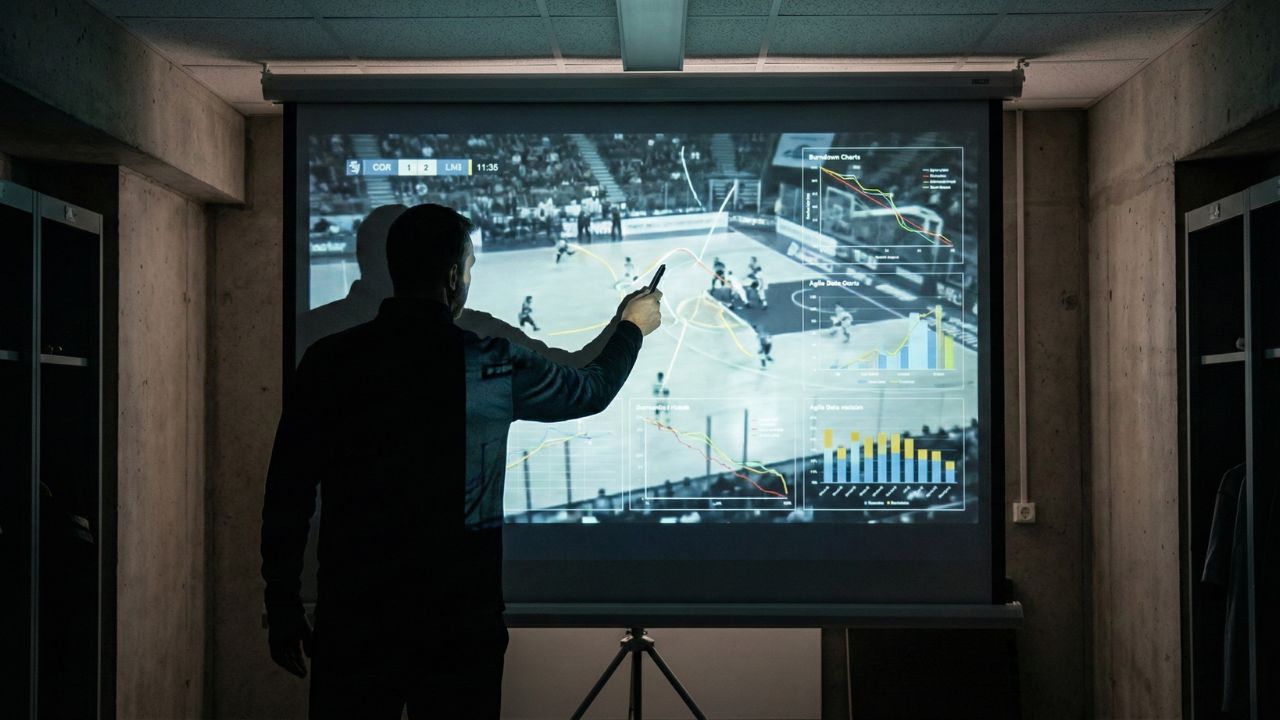
The "Game Tape" Method: Data Over Opinions
After every game, professional athletes watch the tape. They pause, rewind, and analyze every split-second decision.
In Agile, we often rely on memory ("I feel like we were slow"). This is flawed.
Instead, bring your "Game Tape" to the retrospective.
What is your Game Tape?
- The Burndown Chart: Did the line flatten out on Tuesday? Why?
- The Bug Report: Did a specific "play" (feature) result in a turnover (critical bug)?
- Cycle Time: Where did the ball get dropped between the developer and the tester?
By focusing on the "tape" (data), you remove the emotion. You aren't blaming a person; you are analyzing a broken play. This mirrors the "Locker Room Debrief" concept where the goal is clinical analysis, not personal attacks.
The Locker Room Debrief Format
To shake up your routine, try running your next retrospective using this specific sports framework:
1. The Highlight Reel (First 5 Minutes)
Start with the wins. In the locker room, coaches highlight the great plays first to build confidence.
Ask: "Who was the MVP this sprint?" or "What was the 'Play of the Match'?" (e.g., a complex bug fix).
2. The Film Room (20 Minutes)
Pick one specific failure or bottleneck from the sprint. Don't try to fix everything.
The Question: "Why did that play fail?".
The Drill: Trace the failure back to the root cause. Was it a bad pass (unclear requirements)? Or a missed block (environment down)?
3. The Halftime Adjustment (15 Minutes)
In sports, if the opponent is blitzing, you change the blocking scheme. You don't just "try harder."
Identify one tactical change for the next Sprint.
Do not leave the room until you have a plan to practice improvements with team drills.
This ensures you aren't just talking, but training for the next match.
Gamifying the Feedback Loop
One of the best agile retrospective ideas from sports is to introduce a competitive but fun element to the review.
The Penalty Box: If someone is late to the retro or interrupts constantly, they go to the "Penalty Box" (a fun, lighthearted corner) for 2 minutes.
The Assist Award: Instead of just praising the goal scorer (the coder who finished the ticket), give an award to the person who provided the "assist" (the BA who wrote clear specs or the tester who caught a pre-release bug).
This shifts the focus from individual glory to team mechanics.

Frequently Asked Questions (FAQ)
Q: How do sports teams analyze game footage?
Elite teams break down footage frame-by-frame to identify technical flaws and missed opportunities. They look for patterns in the opponent's defense and their own execution errors, treating every play as a data point for improvement.
Q: What is a "Locker Room Debrief" format for Scrum?
It is a retrospective format focused on clinical analysis rather than emotional venting. It involves reviewing the "game tape" (metrics), identifying the specific "broken play" (process failure), and agreeing on a tactical adjustment for the next sprint.
Q: How to run a fun sports-themed retrospective?
Use sports terminology (Sprints, Touchdowns, Fumbles). Introduce awards like "MVP" or "Best Assist." Use a whiteboard designed like a football or soccer pitch to visualize where the team is stuck on the field.
Q: What questions do coaches ask after a loss?
Coaches ask: "Why did that play fail?", "How do we fix the blocking scheme next time?" and "What specific adjustment do we need to make to win the next game?" They focus on the how and why, not the who.
Q: How to turn a team loss into a learning opportunity?
View the loss as data. Just as a team watches tape to see why they lost, an Agile team should look at a failed Sprint to see where the process broke. This builds psychological safety, proving that failure is just a step toward the championship.
Conclusion
If you want your team to perform like champions, you have to treat your retrospectives like a championship team treats the locker room.
By applying these agile retrospective ideas from sports, you transform a boring meeting into a strategic weapon.
You stop complaining about the score and start fixing the game plan.
So, for your next retrospective: bring the whistle, bring the "game tape," and prepare to win.
Sources & References
- Internal Source: Leadership Lessons from Elite Sports Teams: The Agile Captain's Playbook
- Internal Source: Cross-Functional Team Drills
- External Source: McKinsey: The secrets of high-performing teams