The Excalidraw vs Miro for Agile Teams Architecture Secret
Key Takeaways
- Cognitive Load Kills Velocity: Heavy enterprise canvases cause cognitive overload for developers. Lean tools are required for speed.
- The Open-Source Advantage: Your engineering team is secretly using an open-source sketching tool because your expensive enterprise whiteboard is too bloated.
- Fidelity vs. Function: The truth about excalidraw vs miro for agile teams reveals why engineers hate corporate SaaS. Low-fidelity sketching beats pixel-perfect diagramming.
- Security Control: Open-source architecture allows for self-hosting, keeping your proprietary sprint data off third-party cloud servers.
- Developer-Centric Integrations: Embedding lightweight markdown diagrams directly into GitHub PRs is more efficient than forcing developers into a separate SaaS portal.
There is a quiet rebellion happening in your engineering department. While management pushes for standardized, enterprise-wide software, developers are silently abandoning it. Your team is suffering from visual collaboration fatigue.
We analyzed the best agile whiteboarding tools and found most create SaaS bloat. When examining the excalidraw vs miro for agile teams debate, a fascinating architectural secret emerges: less is more.
Stop paying for SaaS bloatware and discover the lean visual collaboration framework your developers actually want. Infinite canvas tools are silently killing your team's cognitive load and sprint velocity.
This deep dive exposes why engineers prefer raw sketching over polished templates, and how you can reclaim velocity by simplifying your tech stack.
The Problem with Heavy Enterprise Canvases
Modern agile development requires speed, clarity, and rapid iteration. However, the tools we give our teams often prioritize presentation over actual problem-solving.
When a developer opens a complex enterprise whiteboard, they are immediately met with templates, color palettes, alignment grids, and endless formatting options. This is a distraction.
Heavy enterprise canvases cause cognitive overload for developers. Instead of mapping out a database schema or planning a sprint, the engineer spends ten minutes making sure their digital sticky notes are perfectly aligned.
Why Low-Fidelity Wins for Technical Architecture
Discover the low-fidelity secret to high-velocity technical planning. When creating technical architecture, the goal is to communicate a concept quickly so it can be debated and improved.
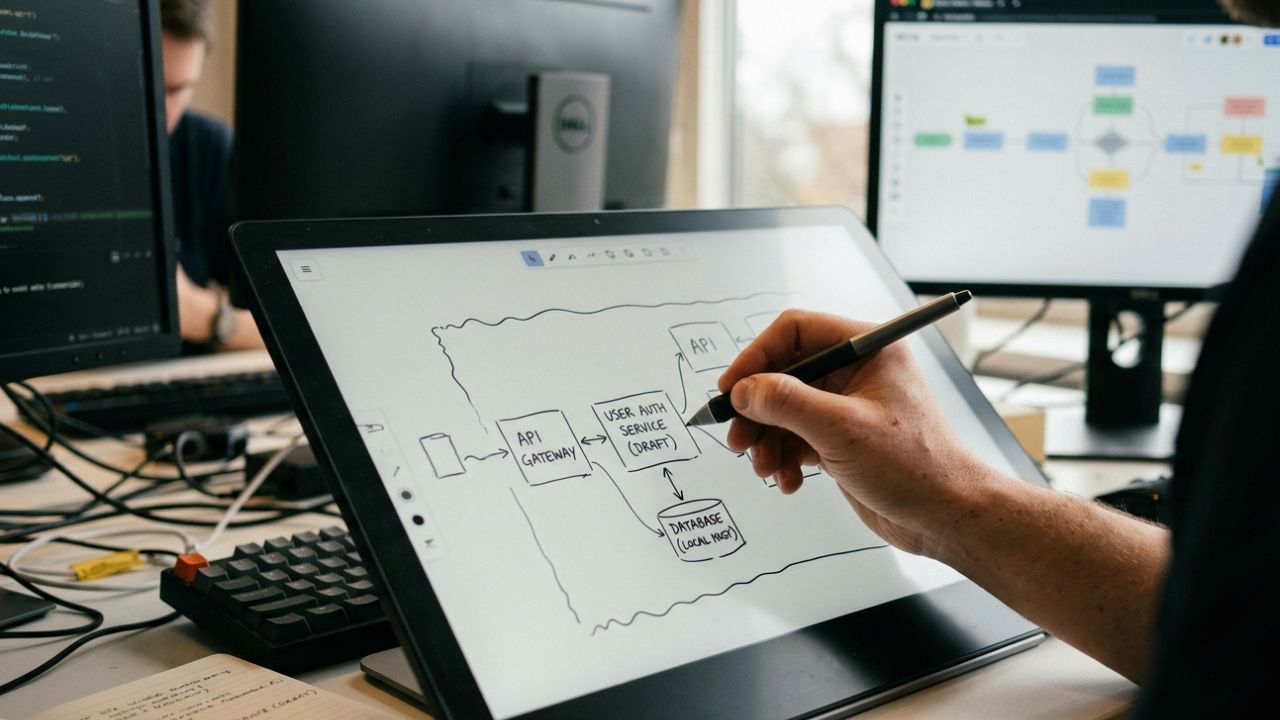
A low-fidelity tool removes the pressure to make things look "good." The deliberately hand-drawn aesthetic of tools like Excalidraw signals to the team that the idea is a draft.
It invites criticism and iteration. In contrast, when a diagram looks polished and corporate, team members are subconsciously less likely to challenge the architecture. They assume it is finalized.
Excalidraw vs Miro for Agile Teams: Evaluating the Architecture
To understand the core differences in the excalidraw vs miro for agile teams matchup, we must look at how each tool handles data, integrations, and user experience from a developer's perspective.
The Bloat vs. The Sketch
Miro is an incredible tool for product managers, designers, and marketing teams. It can host complex wireframes, high-resolution images, and massive dependency maps.
However, engineers rarely need this level of fidelity. They need a digital napkin. Excalidraw provides a minimalist, text-and-shape interface that loads instantly.
When engineers are debating microservices during a sprint planning session, they do not want to wait for heavy UI elements to load. They want the digital equivalent of grabbing a dry-erase marker.
Integration with the Developer Ecosystem
If you are evaluating jira alternatives or lighter ways to manage work, you must consider how your whiteboard integrates.
Enterprise tools often try to keep you inside their walled garden. They offer their own task management features or heavy, clunky bidirectional syncs.
Excalidraw, conversely, thrives on open standards. Developers can easily export diagrams as raw JSON, SVG, or embed them directly into GitHub markdown files. The diagram lives where the code lives, not in a separate silo.
The Open-Source Security Advantage
Perhaps the most critical factor for enterprise architects is data security. When your team maps out your proprietary backend infrastructure, where does that data go?
The truth about excalidraw vs miro for agile teams often comes down to data sovereignty. Enterprise SaaS tools store your proprietary architecture on their cloud.
Because Excalidraw is open-source, your DevOps team can deploy it locally. You can run it on air-gapped internal servers, ensuring that your most sensitive system designs never touch the public internet.
Mitigating IP Leakage
Using third-party cloud whiteboards for high-level architectural planning presents a continuous risk of Intellectual Property (IP) leakage.
If a disgruntled employee leaves, or a cloud vendor suffers a breach, your entire system topography is exposed. Self-hosting mitigates this risk entirely, giving your Chief Information Security Officer (CISO) peace of mind.
Furthermore, it simplifies compliance with strict data regulations, as you maintain complete ownership of the servers and the data residing on them.
Streamlining Your Agile Tech Stack
Your engineering team is secretly using an open-source sketching tool because your expensive enterprise whiteboard is too bloated. It is time to listen to them.
Agile coaches and Scrum Masters should observe what tools the developers reach for organically during ad-hoc meetings.
If they are bypassing the official company tool for a lightweight, browser-based sketchpad, that is a massive signal.
Forcing technical teams to use non-technical, marketing-heavy tools creates friction. By allowing developers to use low-fidelity, open-source alternatives, you remove the friction and accelerate sprint planning.
Conclusion: Stop the SaaS Bloatware
In the battle of excalidraw vs miro for agile teams, the winner depends entirely on the audience. For cross-functional brainstorming and high-fidelity design work, enterprise tools are fantastic.
But for raw engineering, technical architecture, and sprint planning, lean open-source tools reign supreme.
Stop paying for SaaS bloatware and discover the lean visual collaboration framework your developers actually want. Empower your engineers with tools that reduce cognitive load, prioritize speed, and secure your proprietary data.

Frequently Asked Questions (FAQ)
Why do developers prefer Excalidraw over Miro?
Developers prefer Excalidraw because of its minimalist, low-fidelity interface that mimics a physical whiteboard. It prevents teams from wasting time on pixel-perfect designs, keeping the focus strictly on technical architecture, system flow, and rapid problem-solving without UI distractions.
How does excalidraw vs miro for agile teams compare on security?
Security teams often favor Excalidraw because it offers end-to-end encryption and can be fully self-hosted. In contrast, Miro operates primarily as a cloud-based SaaS, which means sensitive proprietary architecture diagrams are stored on third-party servers, increasing potential exposure.
Can Excalidraw integrate with GitHub or Jira?
Yes, Excalidraw integrates well with developer ecosystems. While Miro has heavy native Jira apps, Excalidraw relies on lightweight embeds, GitHub markdown support, and browser extensions that allow engineers to paste architecture diagrams directly into pull requests and Jira tickets seamlessly.
Why is a low-fidelity whiteboard better for technical architecture?
A low-fidelity whiteboard is better for technical architecture because it eliminates the pressure to create polished presentations. Engineers sketch faster, communicate raw ideas more effectively, and iterate rapidly without getting bogged down by formatting tools, fonts, or alignment grids.
Can you self-host Excalidraw for enterprise security?
Yes, you can self-host Excalidraw for enterprise security. Being open-source, your DevOps team can deploy it on internal, air-gapped servers. This guarantees that your proprietary system designs and sprint planning data never leave your company’s private network.